
Recreational vs Technical Diving: What’s the Difference?
In recreational diving, the objective is relatively simple:
👉 Enjoy the underwater world while remaining within established recreational limits.
In technical diving, the approach changes.
👉 The diver learns to plan and manage more complex dives that may involve decompression obligations, greater depth, multiple gases, redundancy or overhead environments.
Technical diving is not simply about going deeper.
It is about developing a higher level of control, planning, precision and problem-solving.
What Changes When You Move into Technical Diving?
Technical diving can introduce several elements beyond conventional recreational diving:
- Greater depths
- Planned decompression
- Multiple breathing gases
- Redundant equipment
- Overhead environments such as caves and wreck penetration
- Advanced gas management
- More detailed dive planning
- Specific emergency procedures
👉 Instead of simply following a dive profile, the technical diver learns to build and manage the entire dive.
Technical Diving Equipment: From Comfort to an Optimized System
Moving toward technical diving often involves significant changes in equipment configuration.
Typical Recreational Configuration
- Conventional BCD
- Single cylinder
- Primary regulator and alternate air source
- Equipment primarily designed for straightforward recreational diving
Technical Configuration
Depending on the type of diving, this may include:
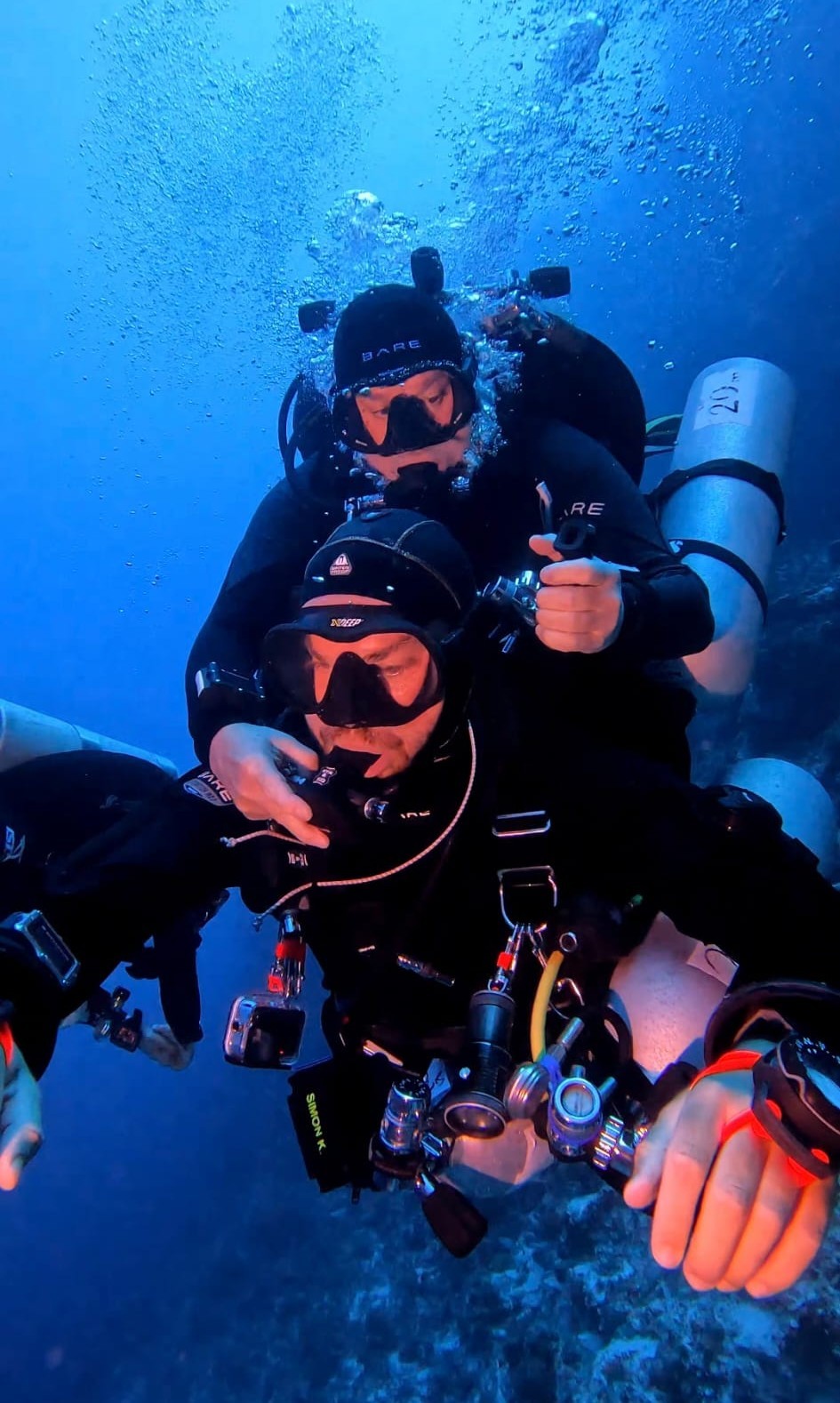
- Twinset or sidemount
- Wing and harness
- Long hose, typically around 2 to 2.1 meters
- Backup regulator on a necklace
- Additional decompression or stage cylinders
- Redundant equipment
- Streamlined configuration
Every piece of equipment has a specific purpose.
👉 The objective is to create a coherent diving system, rather than simply adding more equipment.
The Long Hose and Gas-Sharing Procedures
The long hose is widely used in many technical diving configurations.
During a gas-sharing emergency, the diver can donate the regulator they are breathing from while switching to the backup regulator positioned beneath the chin.
This configuration can provide:
- A predictable donation procedure
- Greater distance between divers when necessary
- Better mobility during an ascent
- More space in restrictive environments
- Standardized team procedures
The objective is not simply to carry a second regulator, but to create a gas-sharing system that remains practical during a real emergency.
Trim and Buoyancy: The Foundations of Technical Diving
Good body control is fundamental in technical diving.
Trim
Trim refers to the diver’s position and balance in the water, with a stable horizontal position commonly used for technical and overhead diving.
Buoyancy
Buoyancy control allows the diver to maintain the required depth without unnecessary vertical movement.
Important objectives include:
- Stable depth control
- Controlled body position
- Minimal unnecessary movement
- Efficient gas consumption
- Precise control during decompression stops and procedures
👉 A technical diver should be able to remain stable while performing other tasks.
Technical Finning: Efficiency and Precision
Technical diving introduces propulsion techniques designed to provide greater control and reduce unnecessary movement.
These can include:
- Frog kick
- Modified flutter kick
- Back kick
- Helicopter turn
These techniques allow divers to control their position more precisely, particularly around fragile environments or where disturbing sediment could significantly reduce visibility.
👉 Every movement should have a purpose.
Twinset vs Sidemount
Two common configurations used in technical diving are back-mounted twin cylinders and sidemount.
Twinset
A twinset provides a large back-mounted gas supply and, with an appropriate manifolded configuration, redundancy and gas-management options.
It is widely used for technical and decompression diving.
Sidemount
In sidemount diving, cylinders are positioned alongside the diver’s body.
This configuration can provide:
- Independent cylinder management
- Excellent access to valves and regulators
- Flexibility
- Streamlining
- Advantages in certain cave and restricted environments
👉 They are different equipment systems that can both be used to achieve redundancy and effective gas management when properly configured and trained.
Decompression: Understanding Rather Than Fearing It
In recreational no-decompression diving, the profile is planned to remain within no-decompression limits.
Technical diving may involve planned decompression obligations.
The diver must therefore understand and manage the ascent rather than simply ascending directly to the surface.
This can involve:
- Planned ascent rates
- Decompression stops
- Different breathing gases
- Gas-switch procedures
- Sufficient reserves for normal and emergency situations
👉 Decompression becomes an integral part of the dive plan.
Understanding Gradient Factors
Gradient Factors (GF) are commonly used with Bühlmann decompression algorithms to modify how decompression is calculated.
They are generally expressed as two values, such as:
GF Low / GF High
The two values influence different parts of the decompression profile and should not simply be interpreted as “low = safer” and “high = less safe.”
Changing Gradient Factors can alter where decompression begins and how decompression is distributed throughout the ascent.
👉 They are tools for adjusting a decompression strategy and should be understood in the context of the decompression model being used.
Dive Planning: One of the Biggest Differences
Planning is a fundamental component of technical diving.
Depending on the dive, this can include:
- Bottom gas
- Decompression gases
- Gas consumption
- Minimum gas or reserve strategy
- Bottom time
- Maximum depth
- Ascent profile
- Decompression obligations
- Gas switches
- Equipment failures
- Emergency scenarios
The plan must also consider what happens if something does not go as expected.
👉 Technical diving requires thinking about the dive before entering the water.
Drysuit and Thermal Protection
Thermal protection becomes increasingly important as dives become longer, deeper or involve significant decompression.
In appropriate environments, a drysuit can provide important thermal protection and becomes another part of the diver’s buoyancy and equipment-management skills.
Cold is not simply a comfort issue.
Loss of thermal comfort can affect concentration, dexterity and overall performance during a demanding dive.
👉 Thermal protection must therefore be appropriate for the environment and planned exposure.
Training, Repetition and Discipline
Technical diving requires more than equipment.
Divers progressively develop:
- Buoyancy control
- Trim
- Propulsion techniques
- Breathing control
- Situational awareness
- Stress management
- Team communication
- Equipment management
- Emergency procedures
Skills must be practiced until the diver can perform them while maintaining control of depth, position and awareness.
👉 The objective is to replace improvised reactions with trained and appropriate procedures.
Technical Diving in the Cenotes of Mexico
At Halocline Explorers, technical diving is not simply something we discuss in a classroom.
We practice and teach in one of the world’s most extraordinary underwater environments:
👉 The cenotes of Mexico’s Yucatan Peninsula.
These environments can provide exceptional conditions for developing advanced diving skills, depending on the training level and site.
They also introduce divers to an extraordinary underwater world of limestone formations, submerged passages, crystal-clear water and natural phenomena such as haloclines.
A Training Philosophy Based on Real Diving
Our approach emphasizes:
- Streamlined equipment configurations
- Precise trim
- Stable buoyancy
- Efficient propulsion
- Rigorous dive planning
- Gas management
- Appropriate emergency procedures
- Situational awareness
👉 The objective is not simply to perform exercises, but to integrate these skills into real diving.
Advanced Diving Equipment and Configurations
Depending on the environment, objectives and training, technical divers may use:
- Twinsets
- Sidemount
- Long-hose regulator configurations
- Wing and harness systems
- Stage and decompression cylinders
- Drysuits
- Other redundant equipment
There is no reason to impose one configuration for every environment.
👉 The equipment must be appropriate for the dive, the environment and the procedures in which the diver has been properly trained.
A Structured Progression into Technical Diving
Progression into technical diving should be gradual.
It can involve developing:
- Precise buoyancy control
- Stable trim
- Advanced propulsion techniques
- Equipment management
- Gas planning
- Decompression knowledge
- Technical diving procedures
- Skills for more demanding environments
Each stage creates a stronger foundation for the next.
👉 The objective is consistent progression rather than simply reaching greater depth.
Technical Diving Is About More Than Depth
Becoming a technical diver does not simply mean diving deeper.
It means diving with:
- More control
- More precision
- More planning
- More awareness
- Greater understanding of equipment and procedures
At Halocline Explorers, we apply this philosophy every day in Mexico, combining technical discipline, real-world experience and a passion for underwater exploration.
Interested in Technical Diving?
Take your diving to the next level and discover a more advanced approach to planning, equipment and underwater control.
➜ Discover our technical diving courses in Mexico




Why Choose Halocline Explorers for Your Training?
At Halocline Explorers, we provide personalized diving courses and advanced diving experiences with experienced and highly qualified instructors.
Our approach emphasizes quality training, small groups, strong fundamental skills and real progression.
Whether your goal is to improve your buoyancy and trim, move into sidemount, learn decompression procedures or progress toward more advanced technical diving, the objective remains the same:
to develop a more capable, controlled and independent diver.