
How to Start Cave Diving in Mexico: Complete Guide to Cavern, Intro to Cave and Full Cave Training
Last updated: August 2026
Open Water
↓
Advanced Open Water
↓
Sidemount
↓
Cavern
↓
Intro to Cave
↓
Full Cave
↓
Technical Cave
Imagine swimming through a passage formed millions of years ago, surrounded by perfectly preserved stalactites, in water so clear that you sometimes feel as though you are flying rather than swimming.
Cave diving is often considered one of the most demanding disciplines in scuba diving, but also one of the most fascinating.
Yet every cave diver started in exactly the same place: with their first course and a progressive training pathway.
Exploring passages formed over millions of years, diving through extraordinarily clear water and discovering environments that very few people will ever have the opportunity to see is a unique experience.
But unlike open-water diving, diving in an overhead environment cannot be improvised.
When a diver enters a cave, a direct ascent to the surface is no longer possible in an emergency. Every decision, every movement and every procedure must therefore be anticipated and executed with discipline.
This is why specialized training agencies such as IANTD — International Association of Nitrox and Technical Divers have developed progressive training pathways designed to build the knowledge and skills required to dive responsibly in this unique environment.
Each level introduces new skills and prepares the diver for the next stage through a methodical progression based on the philosophy of IANTD training standards.
At Halocline Explorers, we offer this complete progression in the cenotes of the Yucatán Peninsula, from the first techniques introduced during Cavern training through Introductory Cave and Cave Diver, commonly referred to by many divers as Full Cave, with the possibility of progressing later toward more advanced programs such as Technical Cave.
Discover our Cave Diving Training in Mexico
In this guide, we will look at each stage of this progression, the skills developed during each course and why Mexico has become one of the world’s leading destinations for learning cave diving.
“Cave diving does not reward the fastest divers. It rewards those who master the fundamentals.”
Julien Garnier
Why Learn Cave Diving in Mexico?
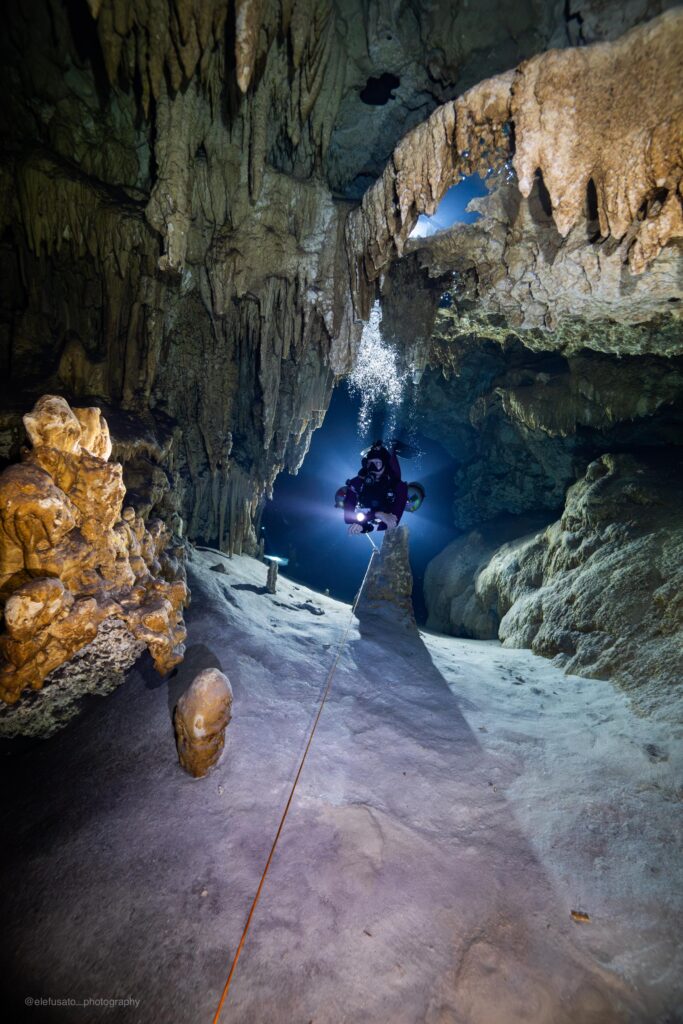
Every year, divers from around the world travel to the Yucatán Peninsula to complete cave-diving training in an environment renowned for the extraordinary variety and quality of its cenotes.
The Yucatán Peninsula is widely recognized as one of the world’s major cave-diving destinations.
Beneath the Mexican jungle lies an immense network of underground rivers connecting hundreds of cenotes.
These passages, naturally carved through limestone over millions of years, provide an exceptional training environment thanks to often extraordinary visibility, stable water temperatures throughout the year and an incredible variety of cave configurations.
More than 1,500 kilometres of underwater passages have already been explored across the Yucatán Peninsula, making this region home to some of the largest known flooded cave systems in the world.
New passages and connections continue to be discovered.
Some cavern zones are enormous and filled with natural light, while others contain narrower passages, depth changes, spectacular haloclines or much more complex navigation.
This diversity allows divers to progress naturally without needing to change region or completely change diving conditions.
This is one of the reasons why divers from Europe, North America, Asia and Australia travel to Mexico every year to begin their cave-diving education or refine existing skills.
Beyond the exceptional quality of the sites, the Riviera Maya also has an important community of specialist instructors, infrastructure adapted to technical diving and access to some of the largest known underwater cave systems.
This combination makes the region an outstanding environment in which to learn, progress and develop as a cave diver.
Why Does Cave Diving Require Specific Training?
💡 Key Point
Cave diving is not about always going farther.
It is about progressively becoming a diver capable of managing every situation calmly, methodically and precisely.
One question frequently comes up among divers discovering the cenotes:
Why do I need specific training if I am already an experienced diver?
The answer is simple.
Cave diving is not simply a more advanced version of recreational diving.
It is a different discipline, with specific procedures, equipment considerations and safety principles.
In an overhead environment, a direct ascent to the surface is not available.
The diver must be capable of maintaining orientation, following a continuous guideline, communicating effectively with teammates, managing gas emergencies or loss of visibility and solving potential problems while remaining calm and controlled.
These skills cannot be improvised.
They are developed progressively through repeated exercises performed in controlled environments under the supervision of a qualified instructor.
This progressive development lies at the heart of the IANTD cave-diving pathway.
Each training level introduces new skills without skipping the foundations, allowing reliable procedures to become automatic over time.
At Halocline Explorers, we strongly support this approach.
Our objective is not to produce certified cave divers as quickly as possible.
Our priority is to develop competent, self-reliant divers capable of making appropriate decisions when they eventually enter a true cave environment.
Why We Recommend Starting With Sidemount Training
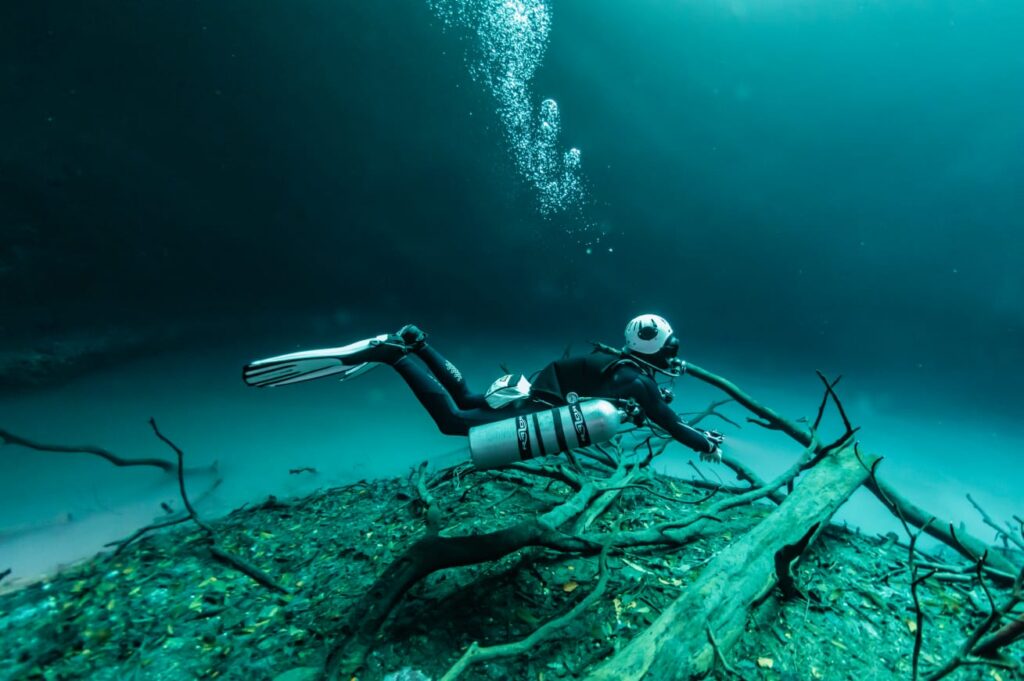
At Halocline Explorers, we generally recommend completing a Sidemount course before beginning the cave-diving progression.
Discover the Sidemount Diver Course in Playa del Carmen
This step is not necessarily mandatory in every cave-diving pathway, but we consider it one of the best foundations for learning to dive in overhead environments.
The sidemount configuration provides several advantages in the cenotes of the Yucatán.
Because the cylinders are positioned along each side of the body, the configuration can improve underwater balance, help maintain a stable horizontal position and contribute to precise buoyancy control.
It also provides direct access to cylinder valves and regulators, simplifying equipment management if a problem occurs.
In narrower passages, sidemount can also provide greater freedom of movement than some traditional back-mounted configurations.
But the main advantage of the course is not simply the equipment itself.
During approximately two days of training, divers develop skills that will remain useful throughout their cave-diving progression:
- improving trim;
- refining buoyancy;
- learning propulsion techniques suitable for fragile environments;
- manipulating equipment precisely;
- correctly managing two independent cylinders.
These skills then allow the diver to dedicate more attention to the new cave-specific procedures introduced during Cavern training.
For this reason, we generally recommend the following progression:
- 2 days of Sidemount training
- 2 days of Cavern training
- 3 days of Intro to Cave training
- 3 days of Cave Diver / Full Cave training
This represents approximately 10 days of progressive training, allowing the diver to develop the skills required for cave diving step by step.
Cavern Training: Your First Step Into the Overhead Environment
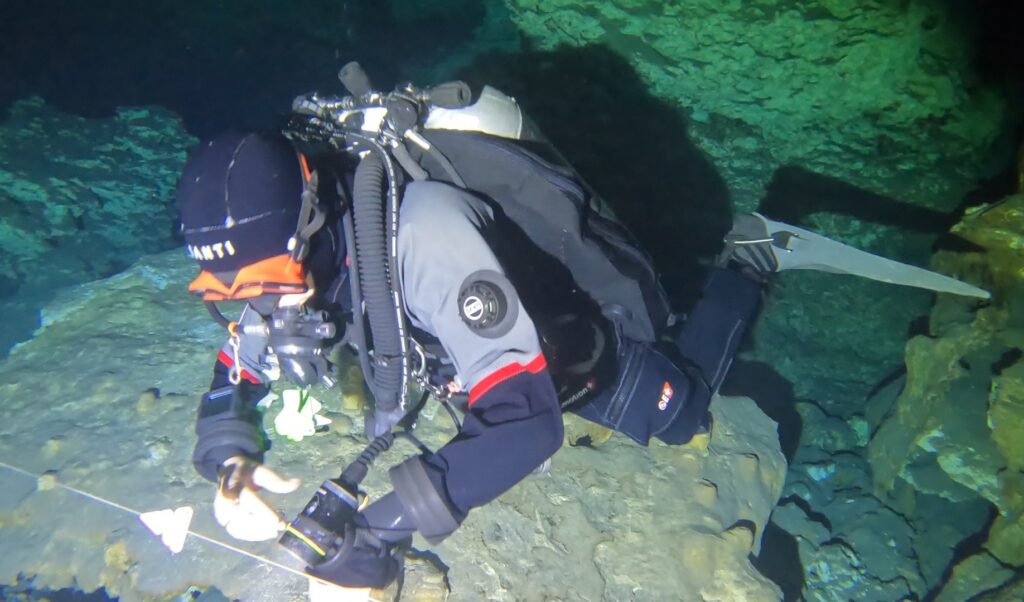
The Cavern Diver course is the true gateway into overhead-environment diving.
Explore the IANTD Cave Diving Training Pathway
Unlike a recreational guided cenote dive, where the guide manages navigation and the overall dive plan, this course teaches you to understand the fundamental principles that make overhead-environment diving possible.
The Cavern level develops the skills required to dive within the natural-light zone, where the exit remains visible, while introducing the diver to personal responsibility and risk management in an overhead environment.
The objective at this stage is not to penetrate farther into a cave.
The objective is to learn how to dive correctly.
Every exercise is designed to develop procedures that will become essential at the following levels.
You will work on skills including:
- maintaining precise buoyancy to protect limestone formations and avoid disturbing sediment;
- correctly using a guideline and understanding its fundamental role;
- deploying a reel and making appropriate tie-offs;
- following a guideline with and without visibility;
- managing a complete loss of visibility while remaining controlled;
- performing a gas-sharing exit with a teammate;
- completing the same exit without visibility while maintaining contact with the guideline.
Beyond the exercises themselves, Cavern training develops a different way of approaching a dive.
The diver learns to anticipate, communicate efficiently with the team, prepare each dive carefully and repeat procedures consistently until they become automatic.
Why Is Cavern Training So Important?
| Training | Typical Duration | Main Objective |
|---|---|---|
| Sidemount | 2 days | Master the configuration and buoyancy |
| Cavern | 2 days | Develop fundamental overhead procedures |
| Intro to Cave | 3 days | Develop autonomy and emergency management |
| Cave Diver / Full Cave | 3 days | Advanced navigation and dive planning |
| Technical Cave | Variable | Cave diving involving decompression procedures |
Many divers consider Cavern simply the first level of cave training.
In reality, it represents much more.
This is where the foundations required for every later stage are developed.
Precise buoyancy, natural use of the guideline, effective team communication and the ability to remain controlled during a loss of visibility will be required during virtually every future cave dive.
The stronger these fundamentals become, the more attention the diver can later dedicate to navigation, planning and more complex situations.
At Halocline Explorers, we prefer to take the time required for each student to genuinely master these fundamentals.
Training duration therefore always depends on the diver’s actual progression.
In most cases, we organize Cavern training over two days, but an additional day can be added when necessary to consolidate specific skills before moving forward.
For us, successful training is not measured by how quickly a course is completed.
It is measured by the quality of the skills acquired.
Intro to Cave Training: The Next Step Toward Autonomy
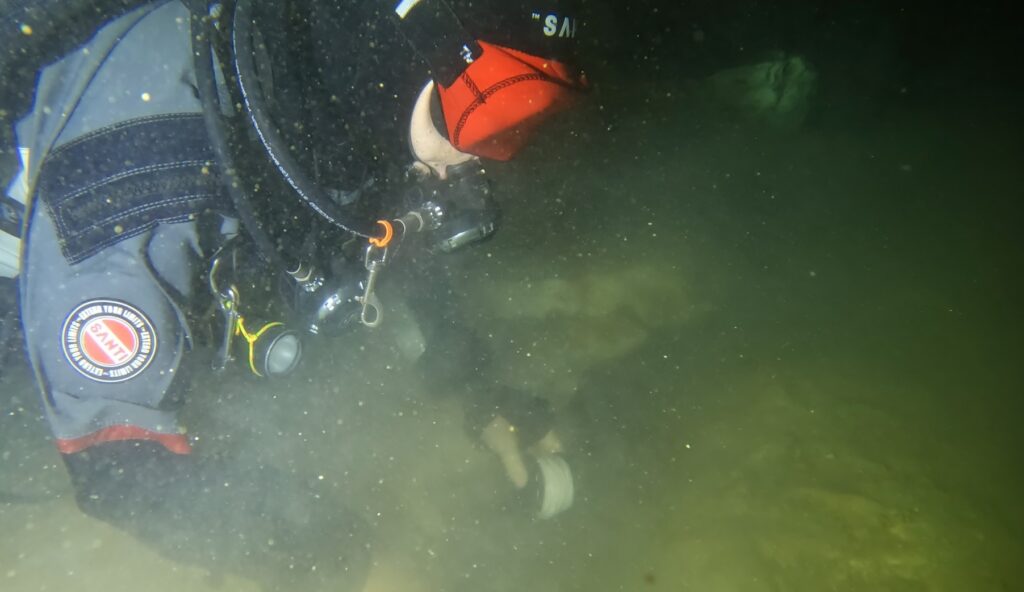
After developing the foundations during Cavern, the diver can continue toward Introductory Cave Diver, commonly called Intro to Cave.
This second stage represents an important progression.
The objective is no longer simply to learn fundamental safety procedures.
The diver begins developing greater independence in a more demanding cave environment.
At this level, the diver progresses beyond the natural-light zone, within the applicable limits of the training level and under instructor supervision during the course.
Exercises become more technical, procedures become more complete and dive management requires greater anticipation.
The skills learned during Cavern should now be increasingly automatic.
Buoyancy, trim, propulsion techniques, guideline following and gas-sharing procedures should require progressively less conscious attention.
This allows the diver to focus on more complex situations.
Skills Developed During Intro to Cave Training
One of the main objectives at this level is learning how to respond appropriately to incidents that can occur during cave diving.
Exercises are introduced progressively in a controlled environment so that each student understands the procedure before dealing with more complex scenarios.
Skills developed include:
- searching for the guideline after losing contact with it;
- managing separation from a teammate and making appropriate decisions;
- dealing with a damaged guideline when the situation requires it;
- improving navigation and movement through more complex passages;
- refining communication procedures and teamwork.
These exercises can intentionally be practised in reduced or zero visibility.
The objective is not to deliberately place the diver in difficulty.
It is to build reliable procedures that remain effective even when stress increases.
Throughout the course, students progressively develop confidence.
They learn to analyze situations, remain methodical and apply the appropriate procedures without rushing.
This ability to remain calm and organized is one of the defining characteristics of a competent cave diver.
Cave Diver / Full Cave Training: Accessing More Complex Cave Navigation
The IANTD Cave Diver course, commonly referred to by many divers as Full Cave, represents a major milestone in the traditional cave-diving progression.
After developing fundamental procedures and greater autonomy, the diver begins learning to plan and conduct significantly more complex cave dives.
The course develops advanced navigation and planning while remaining within the limits of the certification, the diver’s equipment configuration, experience and applicable procedures.
At this stage, basic diving technique should no longer be the principal challenge.
The focus increasingly shifts toward planning.
Every dive requires careful consideration of gas management, the planned route, emergency procedures, team communication and available options if circumstances change.
Cave diving becomes a discipline of preparation, anticipation and decision-making.
Why Does Navigation Become Such an Important Skill?
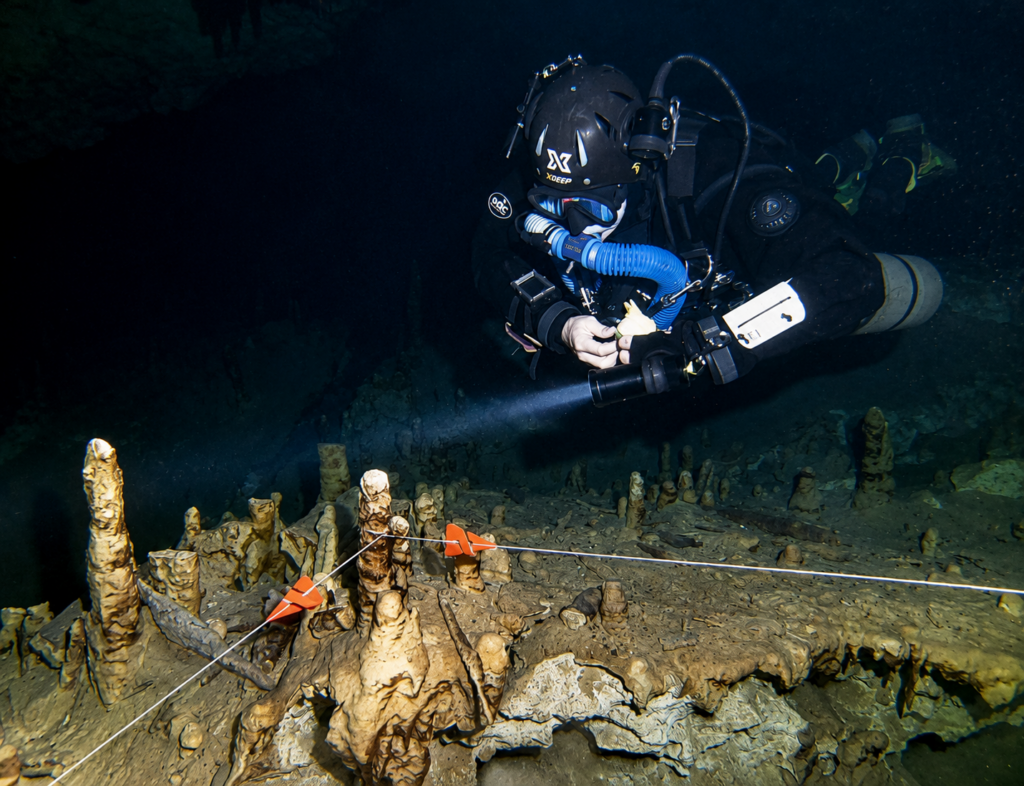
During Cave Diver / Full Cave training, the diver learns to manage more complex navigation than at previous levels.
Depending on the site and training objectives, this can include:
- jumps, allowing a diver to leave one guideline and connect to another passage;
- gaps, allowing continuity to be established between separated sections of guideline;
- circuits, allowing a route to eventually return toward the starting area;
- navigation involving multiple references, lines and changes of direction.
These procedures require discipline and precision.
Navigation errors in an overhead environment can have serious consequences.
Each technique must therefore be explained, demonstrated and practised until it becomes reliable.
Beyond navigation itself, divers also learn to prepare each dive methodically, identify potential risks and develop a coherent dive plan before entering the water.
This planning ability is one of the characteristics that distinguishes an experienced Cave Diver.
What Comes After Full Cave? Technical Cave Training
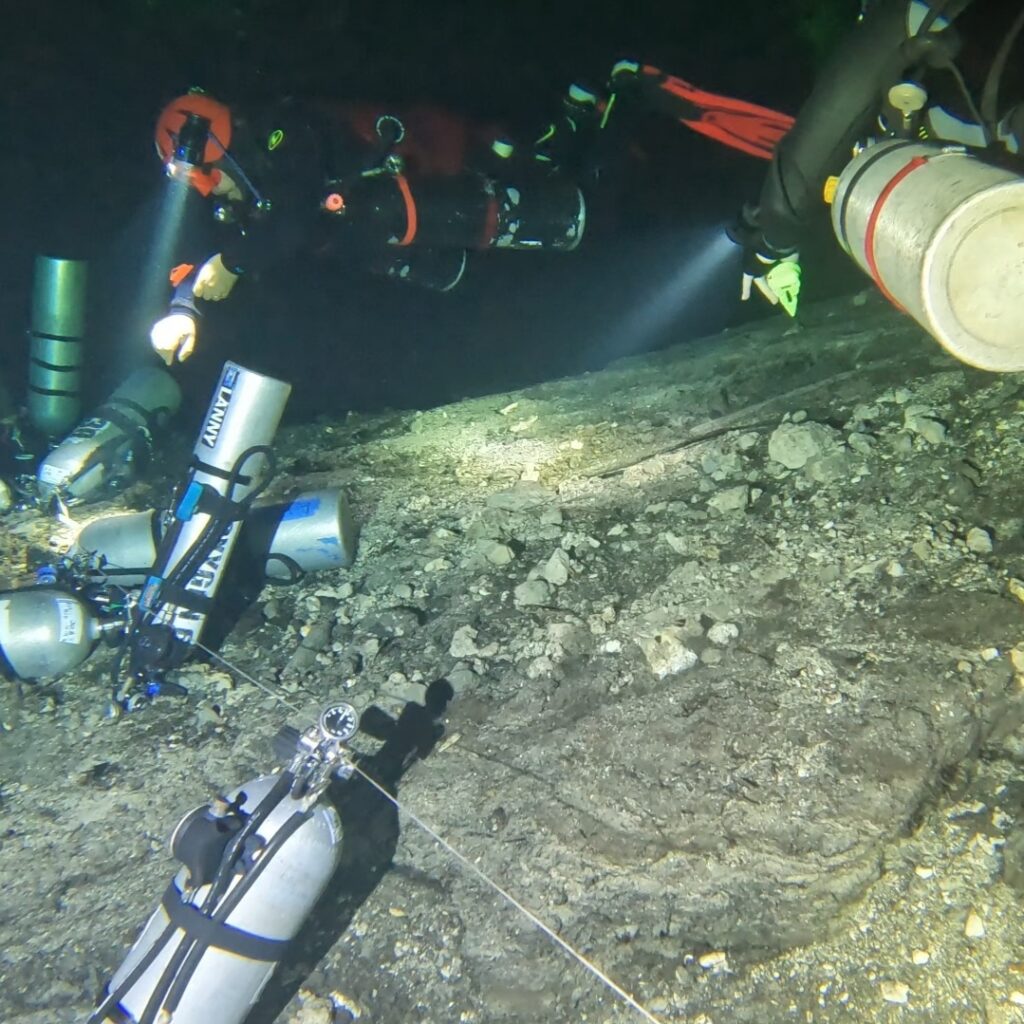
For many cave divers, the Cave Diver certification, commonly called Full Cave, already represents a very high level of autonomy.
It provides access to an enormous variety of cave-diving experiences, provided the diver remains within the limits of their certification, experience and dive plan.
Some divers, however, want to progress farther.
Their objectives may include longer explorations, dives involving decompression gases or expeditions into more demanding cave systems.
This is where Technical Cave training becomes relevant.
Divers interested in progressing toward technical diving can also explore:
Technical Cave training builds on the skills developed during the previous cave-diving progression and adds procedures associated with more advanced cave-diving operations.
Depending on the specific program, the diver may work on:
- planning dives involving multiple gases;
- safely carrying and managing additional cylinders;
- performing gas switches according to disciplined procedures;
- planning longer dives requiring more detailed preparation;
- applying technical cave-diving procedures appropriate to the training level.
As with every previous stage, the priority remains the same:
build solid skills before increasing the complexity of the dive.
What Training Pathway Do We Recommend at Halocline Explorers?
Every diver progresses differently.
Some already have extensive technical-diving experience, while others are discovering the overhead environment for the first time.
This is why we adapt training to the actual ability of each student.
For divers wishing to complete the full progression, we generally recommend the following pathway.
Sidemount Training
Recommended duration: 2 days
The objective is to become comfortable with the sidemount configuration while developing buoyancy, trim, propulsion techniques and management of two independent cylinders.
↓
Cavern Training
Typical duration: 2 days
Introduction to the overhead environment, fundamental procedures, guideline use, loss-of-visibility scenarios and gas-sharing procedures.
↓
Intro to Cave Training
Typical duration: 3 days
Progressive development of autonomy, lost-line procedures, lost-diver procedures, line-related scenarios and more advanced cave skills.
↓
Cave Diver / Full Cave Training
Typical duration: 3 days
More complex navigation, gaps, circuits, dive planning and increased autonomy within the limits of the certification obtained.
The complete pathway therefore represents approximately 10 days of training.
This duration remains indicative.
At Halocline Explorers, progression is always adapted to each diver’s actual skills.
If an additional day is needed to consolidate certain techniques before progressing, we prefer to spend that additional time rather than rush the process.
Our objective is simple:
to develop competent and confident divers, not simply issue certifications.
Why Choose Halocline Explorers for Cave Diving Training?
Cave-diving training represents a significant investment.
Choosing the right instructor is therefore just as important as choosing the training agency.
At Halocline Explorers, we focus on personalized instruction and the real progression of each student.
We prioritize:
- small groups allowing individual attention;
- progression adapted to each diver’s actual level;
- particular attention to buoyancy, trim and propulsion techniques;
- learning through understanding rather than simply repeating exercises;
- progressive training based on the IANTD philosophy.
Our objective is not simply to prepare you to complete a course.
We want every student to finish training with the skills, procedures and confidence required to continue developing responsibly in Mexico’s extraordinary underwater cave systems.
A certification is one stage of the journey.
The skills developed during training will remain with you throughout your diving career.
Preparing for a cave dive with Halocline Explorers.
Learn More About Halocline Explorers
Conclusion
Cave diving is often considered one of the most technical disciplines in scuba diving.
In reality, it is above all a discipline built around precision, discipline and humility.
Each training level introduces new skills that progressively prepare the diver for more complex environments.
By respecting this progression, divers develop strong procedures, learn to manage their equipment, communicate effectively with teammates and make appropriate decisions in an environment where preparation is essential.
The cenotes of Mexico provide an exceptional setting for this progression.
With crystal-clear water, extraordinary cave systems and an enormous variety of environments, the Yucatán Peninsula is one of the world’s outstanding destinations for cave-diving education.
Whether your objective is to discover the overhead environment, become a Cave Diver / Full Cave Diver, or later progress toward Technical Cave, methodical progression remains the best foundation for safe and sustainable cave diving.
At Halocline Explorers, we can guide you throughout this progression.
Explore Cave Diving Training in Mexico
Frequently Asked Questions About Cave Diving Training
Do I Need to Be a Technical Diver Before Starting Cavern Training?
No.
Cavern training is available to divers who meet the prerequisites of the relevant training program.
It is commonly the first stage of the overhead-environment progression and introduces the skills required before advancing toward higher cave-diving levels.
Is Sidemount Training Mandatory?
Not necessarily.
Different appropriate configurations may be used depending on the course and applicable training requirements.
However, at Halocline Explorers we strongly recommend sidemount preparation for many students because it provides an excellent opportunity to develop buoyancy, trim, equipment management and comfort before beginning cave training.
What Is the Difference Between Cavern and Intro to Cave?
Cavern training takes place within the natural-light zone and develops fundamental overhead-environment procedures.
Introductory Cave training progresses beyond natural light and introduces greater autonomy along with additional emergency procedures such as lost-line and lost-diver scenarios.
How Long Does It Take to Become a Full Cave Diver?
At Halocline Explorers, our recommended progression can represent approximately ten days when combining Sidemount, Cavern, Intro to Cave and Cave Diver training.
The actual duration may be adapted according to each student’s experience, skills and progression.
Can I Take Only the Cavern Course?
Yes.
Some divers want to discover overhead-environment diving without immediately progressing toward full cave certification.
Others prefer to continue through the complete progression while maintaining continuity between courses.
Why Learn Cave Diving in Mexico?
The cenotes of the Yucatán Peninsula offer exceptional visibility, stable water temperatures and an enormous variety of sites suitable for progressive training.
These conditions have made Mexico one of the world’s leading cave-diving destinations.
Is Cave Diving Dangerous?
Cave diving involves specific risks because a direct ascent to the surface is not available once the diver enters a true overhead environment.
Proper training, equipment, gas management, planning, teamwork and respect for personal and certification limits are therefore essential.
What Comes After Cave Diver / Full Cave?
Divers wishing to continue their progression can move toward more advanced cave-diving programs, including Technical Cave, provided they meet the relevant prerequisites and have developed sufficient experience.
Explore Technical Diving Courses
Can Cave Diving Training Be Completed Year-Round in Mexico?
Yes.
The cenotes of the Riviera Maya can generally be dived throughout the year.
Water conditions are relatively stable, making cave-diving training possible during every season.
What Equipment Do I Need for Cavern Training?
Equipment requirements depend on the level of training and the configuration being used.
Before your arrival, Halocline Explorers can review your equipment with you so that the configuration is appropriate for your course and objectives.
Every Cave Diver Once Followed Their First Guideline. Could This Be Yours?
Whether you want to discover overhead-environment diving through Cavern, develop greater autonomy through Intro to Cave, become a Cave Diver / Full Cave Diver, or refine your Sidemount configuration, Halocline Explorers can guide you through every stage of the progression.
We focus on small groups, personalized instruction and training adapted to each diver’s pace so that the skills developed are strong, practical and lasting.
👉 Discover Our Cave Diving Training
👉 Discover Our Sidemount Diver Course
👉 Discover the IANTD Cave Diver Course