
Halocline, Thermocline and Hydrogen Sulfide: Understanding the Invisible Layers of Mexico’s Cenotes
The cenotes of the Riviera Maya are much more than natural cavities filled with crystal-clear water. They are complex hydrogeological systems where different layers of water can coexist without completely mixing.
For divers, these phenomena create spectacular visual effects. From a scientific perspective, they are the direct result of differences in water density, temperature and chemistry.
Understanding these invisible layers not only helps divers better understand the environment they are exploring, but also reveals the extraordinary complexity of Mexico’s underground water systems.
1. Cenotes: Stratified Water Systems
A cenote is a natural opening that provides access to an underground water system.
The water inside a cenote is not necessarily uniform. In many cases, it is stratified, meaning that different layers form according to their physical and chemical properties.
Three important phenomena can contribute to this stratification:
- Differences in salinity — halocline
- Differences in temperature — thermocline
- Chemical compounds such as hydrogen sulfide
Under stable conditions, these layers can remain clearly differentiated for long periods of time.
2. The Halocline: Where Fresh Water Meets Salt Water
Scientific explanation
The word halocline refers to a transition zone between bodies of water with different salinities.
In many cenotes of the Yucatan Peninsula:
- Fresh water is found in the upper layers
- Denser salt water can be found deeper underground
- Between them lies a transition or mixing zone known as the halocline
Because salt water has a higher density than fresh water, the two water masses tend to remain vertically stratified.
What does a diver see?
When a diver passes through a halocline:
- Visibility can suddenly become blurred
- Shapes and contours appear distorted
- Objects may seem to shimmer or move
- Other divers can appear partially distorted
The effect is caused by changes in the refractive properties of water with different salinities.
Many divers compare the visual effect to looking through the shimmering air above a hot road on a summer day.
It is one of the most distinctive underwater phenomena found in some of the cenotes of Mexico.
3. The Thermocline: When Water Temperature Changes
Scientific explanation
A thermocline is a layer in which water temperature changes relatively rapidly with depth.
In a cenote, water at different depths may have different temperatures depending on several factors, including sunlight exposure, groundwater circulation and the characteristics of the underground system.
The transition between these water masses creates a thermocline.
What does it feel like underwater?
When passing through a thermocline, a diver may experience:
- A sudden sensation of colder or warmer water
- A noticeable temperature boundary
- Slight visual distortion at the interface
- A rapid change in thermal comfort
The effect can sometimes feel like passing through an invisible wall underwater.
Thermoclines can be particularly noticeable in deeper areas or locations where different bodies of water meet.
4. Hydrogen Sulfide: The Mysterious Underwater Cloud
Scientific explanation
Hydrogen sulfide (H₂S) can be produced through the decomposition of organic material under low-oxygen or oxygen-free conditions.
In certain cenotes, hydrogen sulfide can accumulate at specific depths and create a visually distinctive layer.
These environments may contain very different chemical conditions above, within and below the layer.
What does it look like while diving?
For a diver, a hydrogen sulfide layer can appear as:
- A white or milky cloud
- Underwater fog
- A dramatic boundary between two environments
- A temporary reduction in visibility while passing through it
The visual effect can be extraordinary.
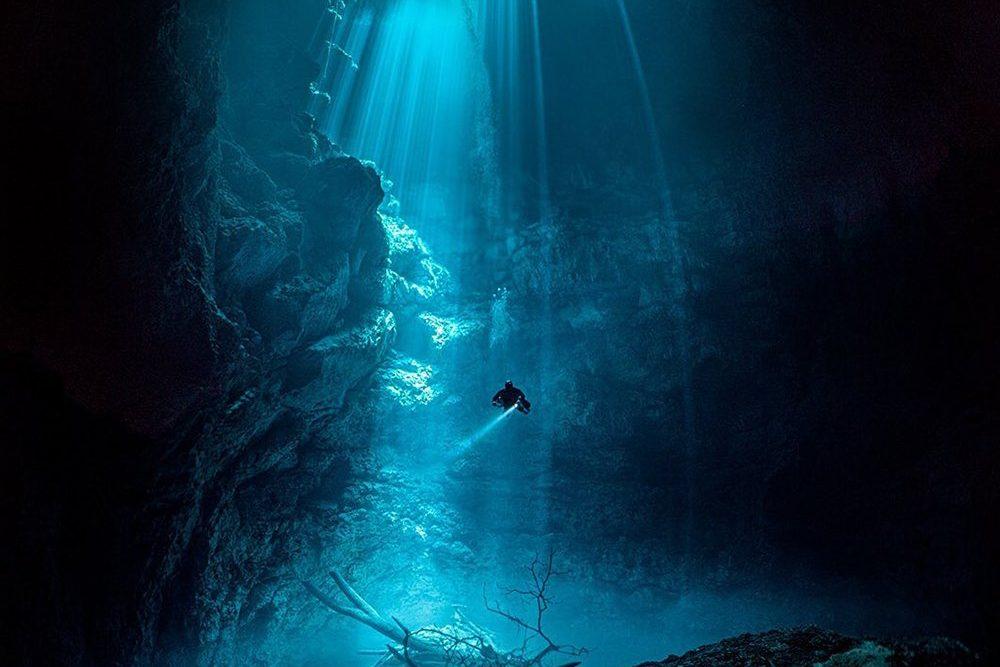
One of the best-known examples in the Riviera Maya is Cenote Angelita, where a dense cloud-like layer creates the appearance of an underwater river or misty landscape.
Another famous environment where divers can observe complex water layers is The Pit.
5. Why Don’t These Water Layers Mix Immediately?
Several physical and chemical factors can maintain stratification inside cenotes.
Density
Salt water is denser than fresh water.
As a result, denser salt water tends to remain underneath the lighter fresh water.
Temperature
Temperature also influences water density.
Different water temperatures can therefore contribute to the formation and stability of separate layers.
Limited turbulence
Underground environments are often protected from the strong wind, waves and surface turbulence found in open water.
This can reduce mixing between different water masses.
Water chemistry
Differences in salinity, oxygen concentration, dissolved compounds and biological activity can create chemically distinct environments within the same cenote.
Together, these factors can produce clearly differentiated layers beneath the surface.
6. Why Are These Phenomena So Spectacular for Divers?
These invisible boundaries are not only scientifically fascinating.
They also create some of the most unusual visual experiences found in underwater environments.
Divers may encounter:
- Mirror-like effects
- Optical distortions
- Dramatic changes in visibility
- Shimmering water boundaries
- Extraordinary light effects
- Cloud-like underwater layers
This combination of geology, water chemistry and light is one of the reasons why cenote diving in Mexico is so different from conventional ocean diving.
For underwater photographers and videographers, these transitions can create exceptional images.
Discover Cenote Diving in Playa del Carmen
7. Tips for Diving Through Haloclines and Other Water Layers
These environments should always be approached with good diving technique and awareness.
A few important points:
- Maintain good buoyancy control
- Keep a stable horizontal position
- Avoid unnecessary movements
- Observe changes in visibility and light
- Use a dive light when appropriate
- Stay close to your guide
- Follow the dive plan and briefing
Good buoyancy and propulsion techniques are particularly useful because they allow the diver to move through these delicate environments without disturbing the surroundings unnecessarily.
Are Haloclines Dangerous?
A halocline itself is not inherently dangerous.
However, the visual distortion created when fresh and salt water mix can temporarily reduce visibility.
For a diver who has never experienced one before, the sudden change can be surprising.
Good buoyancy control, awareness and remaining close to the guide make crossing a halocline straightforward during an appropriately planned cenote dive.
The important point is to understand what is happening rather than becoming disoriented by the unusual visual effect.
Where Can You See Haloclines in the Cenotes of Mexico?
Haloclines are particularly associated with cenotes and cave systems located close enough to the Caribbean coast for deeper salt water to penetrate the underground aquifer.
Their exact depth and intensity vary depending on the cenote and the surrounding groundwater system.
Some dive sites provide particularly impressive examples of these water transitions.
The Riviera Maya therefore offers divers the opportunity to observe hydrogeological phenomena that are rarely encountered in conventional recreational diving environments.
Explore Cenote Diving in Mexico with Halocline Explorers
Why These Layers Matter Beyond Diving
Haloclines, thermoclines and chemically distinct water layers are also important for scientists studying underground aquifers.
They provide information about:
- Groundwater circulation
- Saltwater intrusion
- Chemical processes
- Oxygen distribution
- Biological activity
- Connections between underground water and the Caribbean Sea
The cenotes of the Yucatan are therefore not only spectacular dive sites.
They are also natural laboratories that help researchers understand one of the world’s most extensive underground freshwater systems.
Conclusion
Haloclines, thermoclines and hydrogen sulfide layers are much more than spectacular underwater curiosities.
They reveal the extraordinary physical and chemical complexity of Mexico’s cenotes.
For divers, they can transform an ordinary-looking body of water into an almost surreal underwater environment.
For scientists, they provide valuable information about groundwater circulation, chemistry and the interaction between fresh water and salt water.
These phenomena remind us of something fundamental:
Water beneath the surface is not always uniform.
And nowhere is this more spectacularly visible than in the cenotes of the Yucatan Peninsula.
Discover the Cenotes of the Riviera Maya with Halocline Explorers