
How Much Does Cenote Diving Cost in Mexico? 2026 Prices in Playa del Carmen
Last updated: August 2026
Are you planning a trip to the Riviera Maya and looking forward to discovering Mexico’s famous cenotes? One question almost always comes up before booking:
How much does cenote diving cost in Playa del Carmen?
The price of a cenote diving day depends on several factors: the cenote you choose, entrance fees, transportation, the number of dives, professional guiding, equipment requirements and sometimes the experience level required for a particular site.
For this reason, comparing two cenote diving offers based only on the advertised price can be misleading.
In this guide, we explain how much cenote diving really costs in Mexico in 2026, what is usually included in the price and why some cenotes cost more to dive than others.
How Much Does Cenote Diving Cost in Mexico in 2026?
In Playa del Carmen and throughout the Riviera Maya, a cenote diving day generally includes two dives.
The total price mainly depends on the cenotes selected and the services included by the dive operator or guide.
At Halocline Explorers, our two-dive cenote days currently range from 3,200 to 4,500 MXN per diver, depending on the selected sites.
Here are a few examples:
| 2026 Cenote Diving Program | Price |
|---|---|
| Chac Mool & Kukulkan – 2 dives | 3,200 MXN |
| Dos Ojos – 2 dives | 3,500 MXN |
| Dreamgate – 2 dives | 3,500 MXN |
| The Pit & Dos Ojos – 2 dives | 4,000 MXN |
| Nicte Ha & Taak Bi Ha – 2 dives | 4,000 MXN |
| Taak Bi Luum & Taak Bi Ha – 2 dives | 4,000 MXN |
| Zapote & Maravilla – 2 dives | 4,000 MXN |
| Angelita & Casa Cenote – 2 dives | 4,500 MXN |
| Angelita & Carwash – 2 dives | 4,500 MXN |
| Carwash & Casa Cenote – 2 dives | 4,500 MXN |
These price differences do not necessarily mean that one cenote is “better” than another. They mainly reflect entrance fees, distance, logistics and the type of diving involved.
Why Do Cenote Diving Prices Vary So Much?
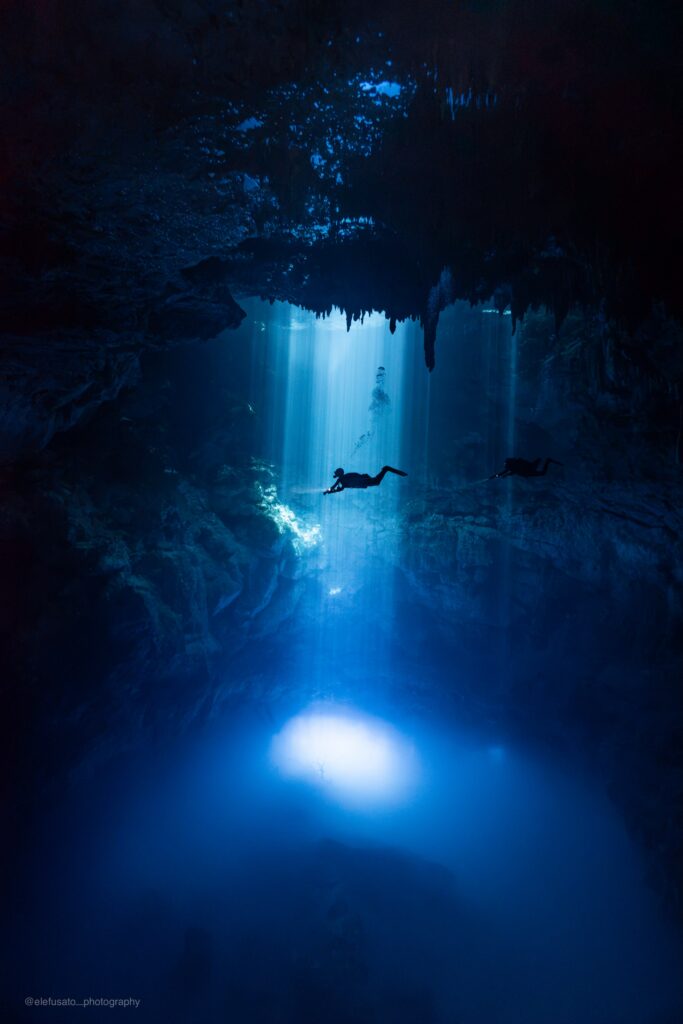
When comparing diving prices in Mexico, you will quickly notice that two days offering the same number of dives can have significantly different prices.
This difference is not simply determined by the dive guide or operator. A cenote diving day involves many different costs: entrance fees, fuel, transportation, vehicle maintenance, tanks, equipment, logistics and professional guiding.
Some of these costs have also increased steadily in recent years.
1. Cenote Entrance Fees
Most cenotes in the Riviera Maya are located on private or community-owned land.
Each site therefore sets its own entrance fees, and these fees can represent a significant part of the cost of a cenote diving day.
Prices are not fixed forever: they can change from one year to another, and dive operators may need to adjust their prices when cenote owners increase their access fees.
There is also an important difference between completing two dives within the same cenote system and combining two completely separate cenotes.
In some systems, two different dive routes can be completed while paying only one entrance fee.
A day such as Angelita & Carwash, however, involves two independent sites. This means paying two separate entrance fees for each diver, as well as covering the transportation between the two cenotes.
This is one of the reasons some combinations cost more even though the total number of dives remains the same.
2. Distance from Playa del Carmen and the Real Cost of Transportation
Distance is another important factor in the price of a cenote diving day.
Unlike diving directly from Playa del Carmen, cenotes are spread throughout a large part of the Riviera Maya and farther inland across the Yucatán Peninsula.
Some are relatively close to Playa del Carmen. Others require considerably more driving.
Angelita, for example, is approximately 75 km from Playa del Carmen.
A diving day at a site like this therefore represents approximately 150 km of round-trip driving, before adding hotel pickups and drop-offs or transportation to a second cenote.
A single cenote diving day can therefore easily involve more than 150 km of driving.
3. Why Is Transportation an Important Part of the Price?
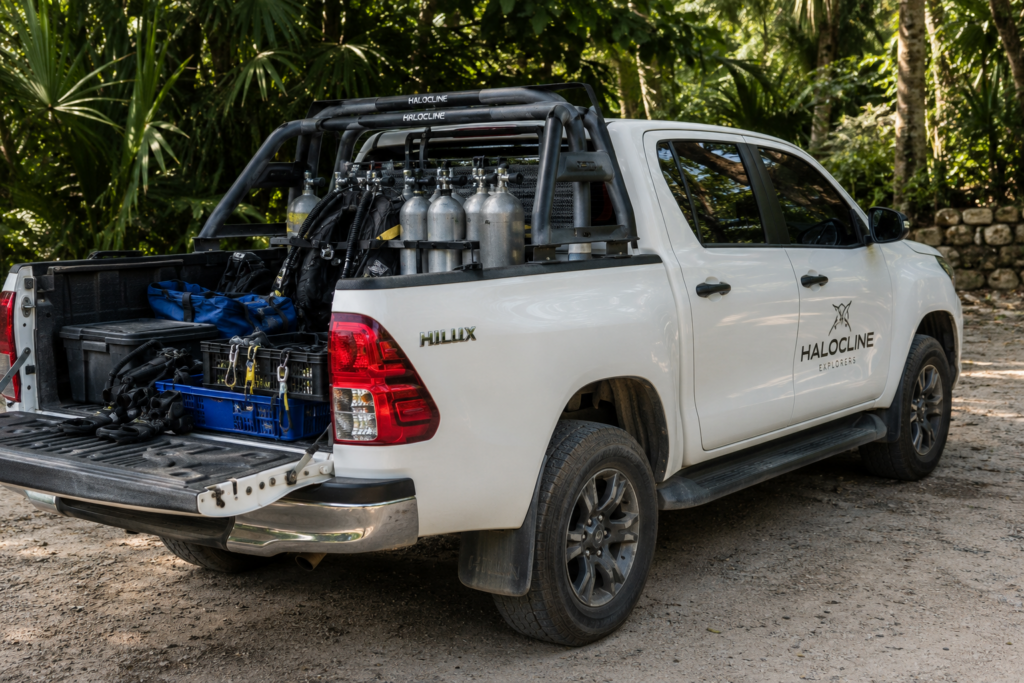
Transporting several divers to a cenote requires much more than simply having a car and paying for a few liters of fuel.
The vehicle needs to carry the divers as well as:
- tanks;
- weights;
- regulators;
- BCDs or other buoyancy systems;
- wetsuits;
- fins;
- dive lights;
- safety equipment;
- water and snacks;
- and all the other equipment required for the diving day.
For this reason, cenote trips are generally operated with vehicles that provide sufficient carrying capacity, particularly vans or pickup trucks.
These vehicles can consume considerably more fuel than a small passenger car, especially when fully loaded and driven long distances every day.
Transportation costs also go far beyond fuel.
A vehicle used professionally for cenote diving trips can cover tens of thousands of kilometers every year. This means regular servicing and oil changes, tires, brakes, suspension components and other wear items, as well as insurance and vehicle depreciation.
Transportation included in the price of a cenote diving day is therefore a real logistical service, not simply a free ride between Playa del Carmen and the dive site.
4. Two Different Cenotes Can Mean Twice the Logistics
Not every two-dive cenote day is organized in the same way.
Consider two examples.
A day involving two different routes within the same cenote system generally requires less transportation between dives and may require only one entrance fee.
A combination such as Angelita & Carwash, on the other hand, involves:
Playa del Carmen → Angelita → Carwash → Playa del Carmen
This means taking into account:
- a greater total distance;
- two separate entrance fees;
- more fuel;
- more driving time;
- more mileage and vehicle wear;
- all the logistics involved in transporting divers and their equipment between two different sites.
This explains why a diving day costing 4,500 MXN is not necessarily more expensive “for the same service” than a day costing 3,200 or 3,500 MXN.
The number of dives remains the same, but the logistics required to complete them can be very different.
The Price of Cenote Diving Is Not Just About Time Underwater
The price paid by the diver covers much more than the two dives themselves: cenote access, transportation, fuel, vehicle maintenance, tanks, equipment, logistics and professional guiding.
Comparing two operators based only on a difference of a few hundred pesos can therefore be misleading.
The right question is not simply:
“How much does the diving cost?”
but also:
“What is actually included in that price?”
What Is Normally Included in the Price of Cenote Diving?
This is probably the most important point to consider when comparing different offers.
A cheaper price is not necessarily better value if you later need to pay separately for cenote entrance fees, transportation or other expenses.
Before booking, always check exactly what is included.
At Halocline Explorers, a standard cenote diving day includes:
- two cenote dives;
- cenote entrance fees;
- round-trip transportation from your hotel in Playa del Carmen;
- professional guiding by an experienced guide;
- groups limited to a maximum of four divers per guide;
- tanks and weights required for the dives;
- water and a snack between dives.
Depending on your personal equipment and the selected diving program, additional equipment may be required.
When requesting a booking, it is therefore always helpful to provide your certification level, diving experience and information about the equipment you already have.
Do You Need to Rent Equipment for Cenote Diving?
That mainly depends on your situation.
If you travel with your own equipment and it is suitable for the planned dives, you can naturally use it.
For divers traveling light, renting equipment can be a much more convenient option.
What Equipment Do You Need?
For recreational cenote diving, the equipment generally includes:
- mask;
- fins;
- wetsuit;
- regulator;
- BCD or another suitable buoyancy system;
- dive computer;
- weights;
- tank;
- an appropriate dive light.
Cenote water temperatures generally remain around 24–26°C (75–79°F), making suitable thermal protection particularly valuable during longer dives.
Before arriving, always check what is included in your booking and what equipment may need to be rented separately.
Why Is Cenote Diving More Expensive Than Regular Ocean Diving?
This is a perfectly reasonable question.
At first glance, cenote diving can seem relatively expensive compared with some shore or boat dives.
However, the cost structure is very different.
A cenote diving day typically involves:
private entrance fees + ground transportation + tanks + specialized guiding + small groups + site-specific logistics.
A standard ocean diving trip can often accommodate a larger number of divers on the same boat with the same crew.
Cenote diving is much more individualized.
The price therefore represents much more than simply “two tanks and two dives.”
You are also paying for access to an exceptional environment, the logistics required to reach it and specialized professional supervision.
Can You Choose the Cheapest Cenote to Save Money?
Yes… but that is probably not the best way to choose your dives.
Some of the most affordable cenotes are absolutely spectacular.
Price is therefore not an indicator of quality.
Likewise, paying more for a remote or more demanding site makes little sense if the cenote is not appropriate for your experience level.
A better approach is:
your certification → your experience → your buoyancy → your preferences → suitable cenotes → your budget.
An Open Water diver discovering cenotes for the first time will not necessarily follow the same program as an Advanced diver with several hundred logged dives.
At Halocline Explorers, we select cenotes according to these criteria to create a coherent diving day rather than simply taking every diver to the most famous site.
Which Cenotes Are Best for a First Experience?
For a first cenote diving experience, Chac Mool and Kukulkan provide an excellent introduction.
Their light effects, large cavern areas and excellent visibility allow divers to progressively discover an environment that is very different from ocean diving.
Dos Ojos is another Riviera Maya classic. Its different routes make it possible to experience two distinct environments during the same diving day.
For more experienced divers, many other possibilities become available, including The Pit, Dreamgate, Angelita, Taak Bi Ha, Zapote, Maravilla and numerous other sites.
The best cenote is therefore not necessarily the most famous one.
Above all, it is the cenote that matches your experience and the type of diving you are looking for.
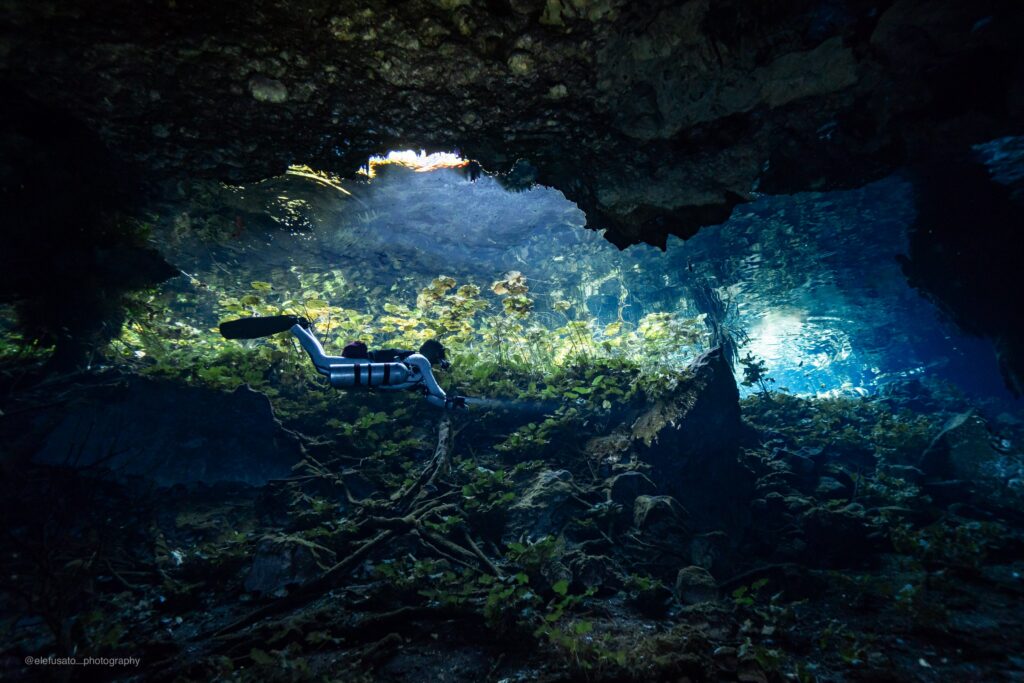
Cenote Diving vs Cave Diving: Know the Difference
A guided cenote dive within the cavern zone and actual cave diving are not the same activity.
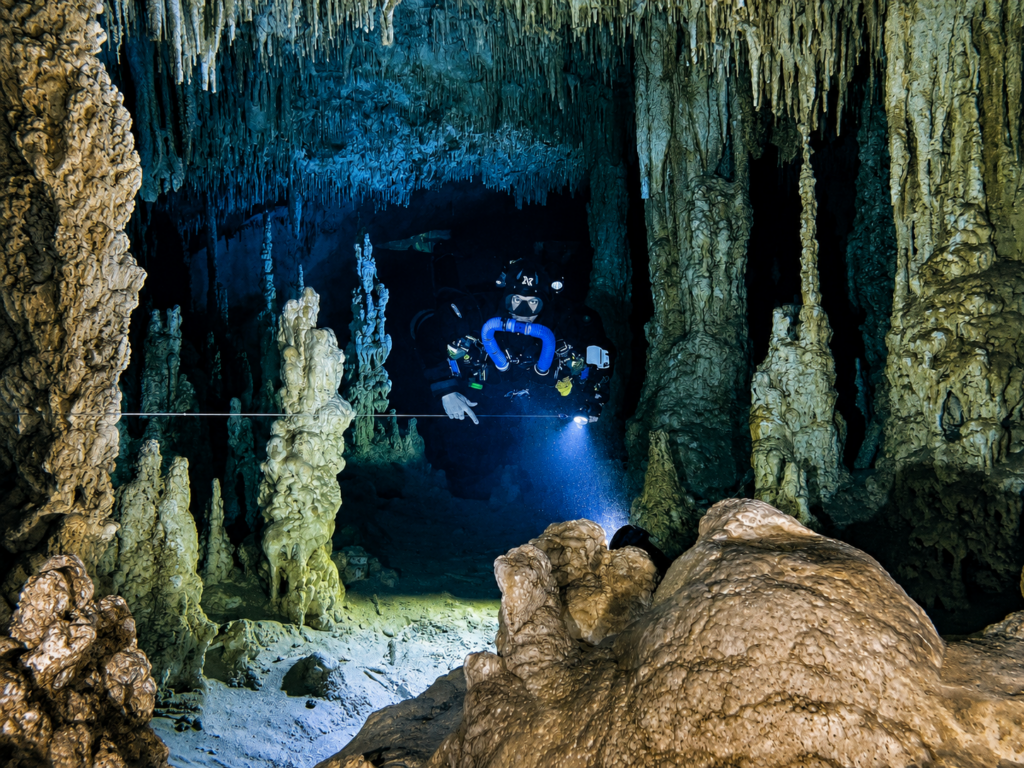
Cavern diving allows recreational divers with the appropriate certification, skills and experience to explore designated areas of cenotes within clearly defined limits.
Cave diving allows divers to progress beyond these limits and requires specific cave diving training, as well as appropriate equipment and procedures for an overhead environment.
An Open Water diver cannot simply pay more to penetrate farther into a cave.
Your certification and training determine the limits of the dive — never the price you pay.
If your goal is eventually to explore the underwater cave systems of the Yucatán Peninsula, the progression continues through specific cave diving training such as Cavern, Introductory Cave and Cave Diver.
How Much Should You Budget for Several Days of Cenote Diving?
If cenote diving is one of the main reasons for your trip, it is worth planning several diving days rather than just one.
Why?
Because two cenotes located only a few kilometers apart can offer completely different experiences.
You can go from the enormous beams of sunlight at The Pit to the spectacular formations of Dreamgate, experience a halocline, submerged vegetation, a hydrogen sulfide cloud or the famous formations of Zapote.
For three days with two dives per day, an indicative budget with Halocline Explorers would therefore generally range from 9,600 to 13,500 MXN, depending on the cenotes selected.
For six diving days, it is better to create a personalized program that alternates different environments and avoids selecting several cenotes offering overly similar experiences.
How Should You Compare Cenote Diving Prices?
Never compare only the advertised number.
Before booking, check:
How many dives are included?
One or two?
Are the cenote entrance fees included?
Is transportation from Playa del Carmen included?
How many divers will be diving with the guide?
Are tanks and weights included?
Is diving equipment included or available at an additional cost?
Does the guide have genuine experience in overhead-environment diving?
Will the cenote be selected according to your experience level?
A difference of only a few hundred pesos can result in a very different experience once all these factors are taken into account.
What Budget Should You Expect for Cenote Diving in Playa del Carmen?
To summarize, current Halocline Explorers prices are generally:
3,200 to 3,500 MXN
For certain two-dive days such as Chac Mool & Kukulkan, Dos Ojos or Dreamgate.
Around 4,000 MXN
For combinations such as The Pit & Dos Ojos, Nicte Ha & Taak Bi Ha, Taak Bi Luum & Taak Bi Ha or Zapote & Maravilla.
Up to Around 4,500 MXN
For diving days requiring more transportation or separate entrance fees, such as Angelita & Casa Cenote, Angelita & Carwash or Carwash & Casa Cenote.
These prices correspond to Halocline Explorers programs in August 2026 and may change if cenote entrance fees or operating costs change.
FAQ — Cenote Diving Prices in Mexico
How Much Does Cenote Diving Cost in Playa del Carmen?
At Halocline Explorers, a cenote diving day including two dives currently costs between 3,200 and 4,500 MXN per diver, depending on the selected sites.
Are Cenote Entrance Fees Included in the Price?
Yes. For the Halocline Explorers programs presented in this article, cenote entrance fees are included.
Is Transportation from Playa del Carmen Included?
Yes. Round-trip transportation from your hotel in Playa del Carmen is included in our cenote diving days.
How Many Dives Are Included in a Cenote Diving Day?
Most of our diving days include two dives. Depending on the cenote, these may be two different routes within the same system or dives at two different cenotes.
What Is the Cheapest Cenote to Dive?
The price depends on entrance fees and logistics. At Halocline Explorers, programs currently start at 3,200 MXN for two dives at Chac Mool and Kukulkan.
However, we recommend choosing a cenote according to your experience level and preferences rather than simply selecting the cheapest option.
Can You Dive in a Cenote with an Open Water Certification?
Yes. Some cenotes and certain cavern areas are accessible to Open Water divers when they have the necessary skills and are appropriately supervised.
Other sites may be more suitable for experienced or Advanced-certified divers, particularly depending on depth and diving conditions.
Do You Need to Be a Certified Cave Diver to Dive in Cenotes?
No. A Cave Diver certification is not required for recreational diving within an appropriate cavern zone.
However, entering beyond the limits of the cavern zone requires specific cave diving training.
Why Are Cenote Diving Prices Increasing?
Entrance fees at many cenotes change regularly, as do the costs of fuel, transportation, vehicle maintenance and logistics.
Diving prices may therefore need to be adjusted when these costs increase. This is why it is always best to check current prices before booking.
What Is the Best Time of Year for Cenote Diving?
Cenotes can be dived throughout the year. Water temperatures and underground conditions remain relatively stable even when ocean conditions are less favorable.
Book Your Cenote Diving in Playa del Carmen
Every diver is different.
Rather than simply choosing a cenote from a list, we can build your diving program around your certification, experience, buoyancy skills, previous dives and what you would like to discover in Mexico.
Halocline Explorers organizes cenote diving in small groups of a maximum of four divers per guide, with transportation from Playa del Carmen and cenote selection adapted to the participants’ experience level.
Whether you are planning your first cenote dive, want to discover several sites throughout the Riviera Maya or eventually progress toward sidemount and cave diving, we can build a program adapted to your stay.
CENOTES • CAVE DIVING • TECHNICAL TRAINING • SMALL GROUPS