
Why Were Cenotes Sacred to the Maya?
The cenotes of the Yucatan Peninsula are known today for their crystal-clear water, limestone formations and spectacular underground landscapes.
For the ancient Maya, however, these natural openings in the rock were much more than simple water reservoirs.
Some cenotes provided water essential for everyday life. Others were associated with religious ceremonies, rain deities, ancestors and forces of the underground world.
They therefore occupied a special place at the boundary between the visible world and an invisible universe inhabited by deities, spirits and natural forces.
Understanding this historical and cultural dimension allows us to see the cenotes we explore today from a different perspective.
Every year, thousands of divers discover the cenotes for their crystal-clear water and incredible light effects. Yet few know that some of these places were considered sacred by the ancient Maya, who saw natural cavities and underground waters as connections with an invisible world.
To better understand these unique environments, discover our Complete Guide to Mexico’s Cenotes.
Cenotes: Sources of Life in the Yucatan Peninsula
The word cenote comes from the Yucatec Maya ts’ono’ot or dz’onot, a term referring to a natural cavity containing water.
Contrary to a commonly repeated idea, the word does not literally mean “sacred well.” The sacred significance of cenotes came from their essential role in Maya life and beliefs, rather than from the literal translation of the word itself.
Much of the Yucatan Peninsula consists of highly permeable limestone. Rainwater rapidly infiltrates the ground, which explains why permanent rivers are rare on the surface.
The Maya therefore depended heavily on:
- cenotes
- water-filled caves
- natural wells
- artificial reservoirs
- underground water
The presence of these water resources influenced the location and development of many communities.
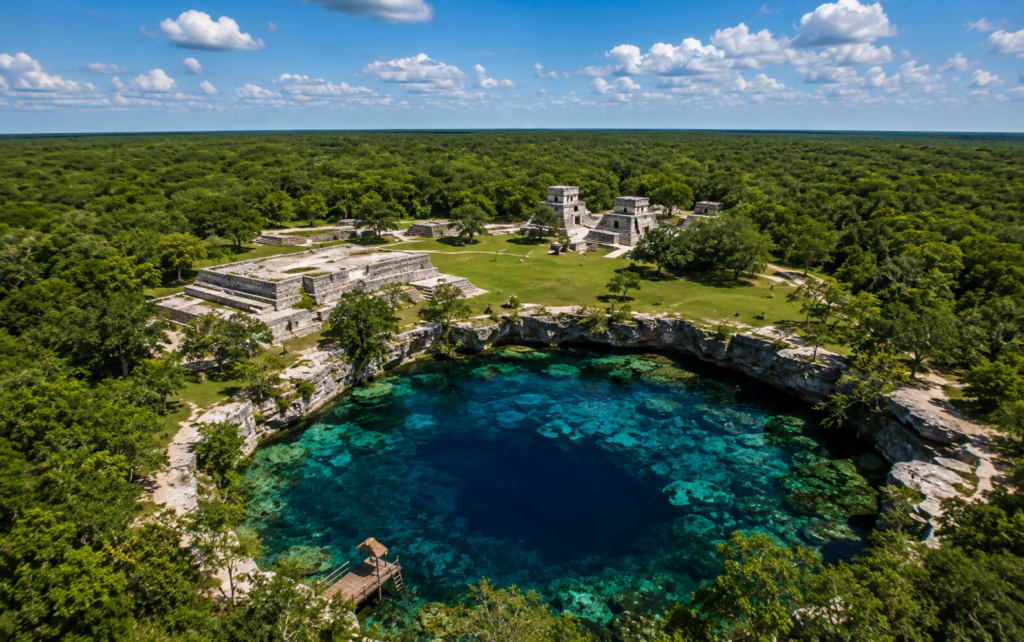
Chichen Itza, for example, developed close to several cenotes. One of them was used particularly for water supply, while the famous Sacred Cenote was associated with rituals, offerings and pilgrimages.
Practical and sacred functions were therefore not necessarily separate. A source of water capable of ensuring the survival of a population could also be perceived as a place where supernatural forces were present.
| Element | Role in Maya Beliefs |
|---|---|
| Cenote | Water source, sometimes a sacred place |
| Chaac | God of rain and fertility |
| Xibalba | Underworld described in the Popol Vuh |
| Alux | Protective spirits of nature according to local traditions |
| Offerings | A means of communicating with deities |
Were Cenotes Entrances to the Underworld?
In Maya religious concepts, caves, natural cavities and certain bodies of water could serve as places of communication with the underground world.
This world did not correspond exactly to hell as represented in Western traditions. It formed part of a complex universe inhabited by deities, ancestors, the dead and forces connected with fertility, rain and renewal.
Openings in the earth could symbolically allow people to:
- communicate with deities
- communicate with ancestors
- ask for rain
- deposit offerings
- perform certain rites of passage
- enter a space different from the ordinary human world
Not every cave and cenote probably had the same function. Their use depended on the location, historical period, accessibility and the communities living nearby.
Xibalba: The Underworld Described in the Popol Vuh
Xibalba is often presented as the Maya underworld.
However, this statement requires some nuance.
The best-known account of Xibalba comes from the Popol Vuh, a fundamental text of the K’iche’ Maya tradition of Guatemala. It should therefore not be considered a single, universal description of the beliefs of every Maya population, particularly those of the Yucatan Peninsula.
In the Popol Vuh, Xibalba is an underground world ruled by powerful lords associated with disease, suffering and death.
The Hero Twins Hunahpu and Xbalanque descend into Xibalba and face a series of trials, traps and dangerous houses. Eventually, they defeat the Lords of Xibalba through their intelligence, their mastery of the game and their ability to transform themselves.
Xibalba is therefore not simply a kingdom of the dead. It also represents a place of trials, transformation and renewal.
The Popol Vuh describes a journey toward Xibalba involving paths and underground spaces. Research into Maya cosmology also shows that caves could be understood as routes connecting the surface with the underground world.
Directly associating every cenote of the Yucatan with Xibalba would nevertheless be an oversimplification. It is more accurate to say that natural cavities and underground waters played an important role in different Maya concepts of the invisible world.
Today, some of these environments can be explored during guided cenote dives, while deeper underground cave systems are reserved for divers trained in cave diving.
Chaac, Rain and Underground Water
Chaac is one of the principal Maya deities associated with rain, storms and agricultural fertility.
In a region affected by periods of drought, rainfall determined the success of crops and the survival of communities.
Rituals addressed to Chaac could therefore seek to:
- ask for rain
- protect crops
- prevent drought
- restore balance between humans and deities
The Sacred Cenote of Chichen Itza is one of the best-documented examples. Objects and human remains have been discovered there, confirming its use as a place for ceremonies, offerings and sacrifices.
According to Mexico’s National Institute of Anthropology and History, this cenote was notably used for rituals associated with Chaac, the god of rain.
However, this does not mean that every cenote was dedicated to Chaac or used for sacrifices. Many primarily supplied water to nearby communities.
💡 DID YOU KNOW?
The Sacred Cenote of Chichen Itza measures approximately 60 meters in diameter and more than 20 meters deep.
Archaeologists have recovered hundreds of ritual objects made of jade, gold, copper and ceramics, as well as human remains dating from different periods of Maya history.
Today, this cenote is considered one of Mexico’s most important underwater archaeological sites.
What Offerings Have Been Discovered in Cenotes?
Archaeological research conducted in different cenotes and caves throughout the Maya region has revealed a wide variety of remains.
Depending on the site, archaeologists have discovered:
- ceramic vessels
- wooden objects
- jade
- obsidian
- ornaments
- metal objects
- textiles
- tools
- animal remains
- human remains
These discoveries do not all have the same meaning.
Some objects may have been deliberately deposited as offerings. Others may have been used during ceremonies, transported by water or accidentally lost.
Their interpretation therefore depends on the archaeological context, the position of the remains, their dating and other elements discovered nearby.
At some sites, valuable objects appear to have been deliberately placed in the water as offerings to deities.
Underground water was therefore not simply a material resource. It could become a means of transmitting an offering toward a realm considered inaccessible to ordinary humans.
Did the Maya Practice Human Sacrifice in Cenotes?
Human sacrifices did occur in certain Maya contexts.
The Sacred Cenote of Chichen Itza is the best-known example, but this practice should not be generalized to every cenote.
Archaeological analyses have identified human remains belonging to men, women and children. Some individuals may have been sacrificed during ceremonies connected with rain, political crises, conflicts or other important events.
However, archaeological knowledge continues to evolve. Older stories describing young virgins systematically being thrown into cenotes are now treated with caution. They were often influenced by colonial chroniclers, popular stories and interpretations from the early days of archaeology.
More recent discoveries reveal a much more complex reality.
Practices varied according to:
- historical periods
- cities
- the status of individuals
- the type of ceremony
- political or environmental circumstances
Sacrifice was therefore neither an everyday practice nor something carried out in every cenote. It was a particular ritual act performed in certain places and under specific circumstances.
Were All Cenotes Sacred?
It is difficult to claim that every cenote was perceived in exactly the same way.
Some were primarily used to collect drinking water. Others were associated with domestic, agricultural or craft activities. Others clearly had ceremonial functions.
A cenote could also serve several different purposes over time.
Its use could change according to:
- the development of a city
- the needs of the population
- water quality
- accessibility
- local beliefs
- political transformations
The Sacred Cenote and Xtoloc Cenote at Chichen Itza illustrate this diversity particularly well. The Sacred Cenote was associated especially with rituals and offerings, while Xtoloc played a greater role in supplying water to the city.
Talking about “sacred cenotes” therefore remains appropriate, but we should avoid considering every natural cavity a temple or place of sacrifice.
Are Alux the Guardians of Cenotes?
The Aluxo’ob, known as Alux in the singular, belong to Maya folk traditions of the Yucatan Peninsula.
They are generally described as small invisible beings associated with fields, forests, ancient constructions and natural places.
According to local stories, Alux can protect land or a community when humans treat them with respect. They may also make noises, hide objects or disturb people who enter certain places without permission.
In some contemporary traditions, people symbolically ask permission before entering the jungle, a cave or a cenote.
However, Alux should not be presented as the official guardians of every cenote throughout ancient Maya religion.
They belong instead to living traditions transmitted orally and varying between families and communities.
These beliefs nevertheless demonstrate that the landscapes of the Yucatan are not necessarily regarded as empty spaces. Forests, caves and bodies of water may be perceived as places inhabited by invisible presences deserving respect and caution.
Beliefs That Still Exist Today
The Maya are not simply an ancient civilization that disappeared.
Millions of people belonging to different Maya peoples live today in Mexico, Guatemala, Belize, Honduras and El Salvador. More than thirty Maya languages are still spoken.
Some practices have naturally evolved under the influence of colonization, Christianity, social change and tourism.
Nevertheless, traditions continue to associate:
- rain with spiritual forces
- caves with ancestors
- the land with invisible presences
- harvests with ceremonies
- cenotes with places deserving particular respect
These traditions should therefore not simply be reduced to tourist legends.
They belong to living cultures, although their meaning varies considerably from one community to another.
A Civilization That Is Still Present
“Cenotes are among Mexico’s most fascinating natural landscapes. They are also one of the most extraordinary gateways to understanding Maya civilization.”
Diving in a Natural Environment Filled With History
For a diver, a cenote is first and foremost an extraordinary natural environment.
Underwater, you can discover:
- beams of sunlight penetrating the water
- stalactites and stalagmites
- passages formed over thousands of years
- exceptional visibility
- layers of fresh and salt water
- a silence very different from the ocean
But these landscapes also have a human history.
Some cenotes supplied water to communities for centuries. Others hosted ceremonies, pilgrimages or ritual offerings.
Diving in a cenote does not automatically mean entering an ancient Maya sanctuary. It does, however, mean exploring a landscape that played an essential role in the development, survival and beliefs of the people of the Yucatan Peninsula.
Diving Safely in a Cenote
At Halocline Explorers, safety is always our priority.
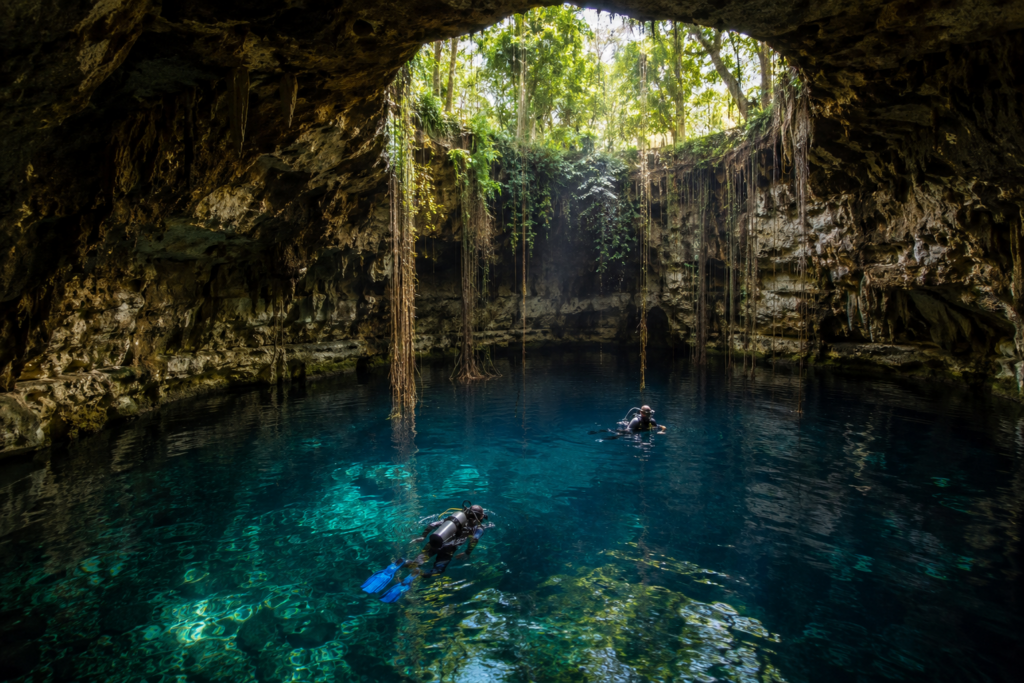
Recreational cenote dives take place exclusively within the natural-light cavern zone, always under the supervision of a qualified guide.
Beyond this limit begins Cave Diving, a completely different environment requiring specific training, appropriate equipment and dedicated safety procedures.
How Should Divers Respect Cenotes?
Respecting these sites begins with simple behavior.
It is particularly important to:
- never touch geological formations or archaeological remains
- never move or remove anything
- maintain excellent buoyancy control
- avoid disturbing sediment
- respect rules established by owners and local communities
- never enter a cave environment without appropriate training
- minimize the use of products that could contaminate the water
- follow the guide’s instructions
Cenotes are fragile environments.
A broken stalactite will not grow back within a human lifetime. An archaeological object moved from its original position may lose essential scientific information. Poor buoyancy control can also damage formations that took thousands of years to develop.
Respecting a cenote therefore means protecting simultaneously:
- a freshwater resource
- an ecosystem
- geological heritage
- archaeological heritage
- cultural heritage
What Should You Remember?
Cenotes occupied a special place in Maya societies because they combined several essential functions.
They could be:
- essential sources of water
- places for ceremonies
- spaces for offerings
- symbols of fertility
- points of communication with the invisible world
- important elements in the organization of landscapes and cities
Some cenotes were clearly associated with Chaac, offerings and sacrifices. Others were used primarily for water supply.
Caves and natural cavities could symbolically lead toward the underground world, but directly associating every cenote with Xibalba should be done with caution.
Traditions surrounding the Alux also demonstrate how respect for natural places remains deeply rooted in regional culture.
A Timeless Experience
Underwater, the silence is almost complete.
Sunlight passes through openings in the limestone, geological formations appear frozen for millennia, and every movement reminds us that these places existed long before the arrival of the first explorers.
It is this unique combination of nature, history and exploration that makes cenote diving so different from almost every other underwater experience.
Conclusion
Cenotes are much more than spectacular geological formations or diving destinations.
They are an essential part of the natural and human history of the Yucatan Peninsula.
For ancient Maya societies, they represented both water essential for life and, in certain contexts, places for communicating with deities and performing important ceremonies.
Even today, their silence, darkness and beauty can create the impression of entering another world.
Understanding their history does more than make a dive more interesting. It also reminds us that we are temporary visitors in a fragile environment that has been used and respected for centuries.
Discovering a cenote means exploring an extraordinary natural landscape.
Understanding it also means recognizing the culture, beliefs and history of the people who have lived above these underground waters for generations.
Would you like to experience it for yourself? Discover our cenote dives in Mexico.
Frequently Asked Questions About Sacred Maya Cenotes
What Does the Word Cenote Mean?
The word cenote comes from the Yucatec Maya ts’ono’ot or dz’onot. It refers to a natural cavity containing water. It does not literally mean “sacred well.”
Were All Cenotes Sacred to the Maya?
No. Some cenotes had ceremonial functions, while others were used primarily for water supply or everyday activities. A particular site could also change function over time.
Did the Maya Systematically Throw People Into Cenotes?
No. Human sacrifices are documented at certain locations, particularly Chichen Itza, but they did not occur in every cenote and were not an everyday practice.
What Is Xibalba?
Xibalba is the underground world described in the Popol Vuh of the K’iche’ Maya. It is ruled by lords associated with disease and death. It also represents a place of trials and transformation.
Was Chaac the God of Cenotes?
Chaac was principally associated with rain, storms and fertility. Certain cenotes, such as the Sacred Cenote of Chichen Itza, were used for ceremonies and offerings associated with this deity.
Are Alux Still Part of Local Beliefs?
Traditions involving Alux remain present in some communities of the Yucatan Peninsula. Their interpretation varies according to regions, families and orally transmitted traditions.
Can You See Maya Artifacts While Cenote Diving?
Archaeological remains exist in certain caves and cenotes, but their locations are generally protected. Divers must never touch, move or remove an object discovered underwater.
Do You Need Special Training to Dive in a Cenote?
The cavern zone can be accessible to recreational divers with the necessary certification and experience, under the supervision of a qualified guide. Entering a cave beyond the cavern environment requires specific cave-diving training.
Halocline Explorers organizes small-group cenote dives throughout the Riviera Maya.
Each dive is selected according to:
- your certification level
- your experience
- your comfort underwater
- site conditions
- your objectives and preferences
We also offer recreational, sidemount, technical and cave-diving training.
Explore the Cenotes of Mexico With Halocline Explorers
Discovering a cenote is not simply about admiring crystal-clear water or spectacular underground landscapes. It means exploring an environment shaped over millions of years and filled with fascinating history.
At Halocline Explorers, we introduce you to the cenotes of the Riviera Maya in small groups, with an approach focused on safety, environmental respect and a better understanding of these extraordinary places.
Whether you are an Open Water diver, Advanced diver or technical diver, we select dive sites according to your level to provide the most appropriate experience.
Our services include:
- Guided dives in the cenotes of the Yucatan
- Diving in Playa del Carmen and Cozumel
- Recreational and technical IANTD training
- Sidemount and Cave Diving training
- Personalized guidance in French, English and Spanish
Ready to Explore the Cenotes of Mexico?
Want to explore underground cave systems beyond the cavern zone?