
Cenote Diving vs Cave Diving in Mexico: What’s the Difference?
Last updated: September 2026
When looking at photos or videos of diving in Mexico’s cenotes, the difference between cenote diving, cavern diving and cave diving is not always obvious.
A diver swims beneath a rocky overhang. The ceiling closes above them. Stalactites appear, and a direct ascent to the surface is no longer possible.
Are they already cave diving?
Not necessarily.
A large proportion of the dives recreational divers make in the cenotes of the Riviera Maya take place within what is known as the cavern zone.
In Mexico, one of the fundamental differences is simple:
in the cavern zone, the maximum distance to an exit must not exceed 60 meters.
In cave diving, this fixed limit no longer applies. Penetration can become much greater, but it is then determined by gas management, navigation, equipment, experience and the diver’s training.
A cenote dive is not necessarily a cave dive
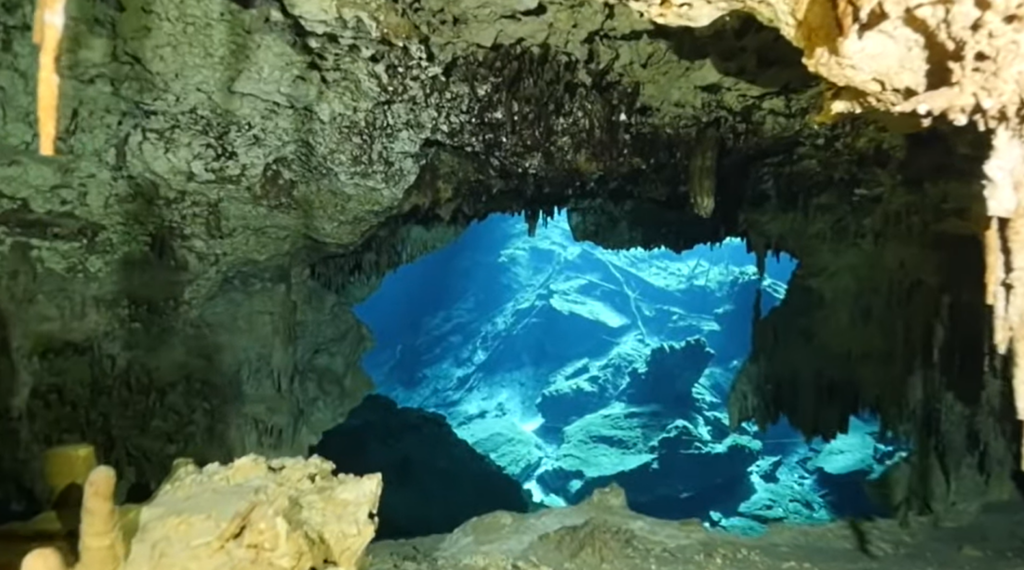
The word cenote does not describe a type of diving. It refers to a natural opening that provides access to the underground waters of the Yucatán Peninsula.
The same cenote can contain a huge opening illuminated by daylight, a cavern zone accessible during a properly conducted recreational dive, and then continue into kilometers of completely submerged underground passages.
Two divers can therefore enter the same cenote and experience two completely different dives.
The first stays within the cavern zone. The second, provided they have the appropriate training and equipment, may continue much deeper into the cave system.
It is not the cenote itself that determines whether you are cavern diving or cave diving. It is where you go within the system and which limits you cross.
Want to experience this environment without being a cave diver? Discover our cenote diving in Playa del Carmen.
What is cavern diving?
The cavern zone is the part of an overhead environment located close to a natural exit.
A diver may already be swimming beneath a solid ceiling, but penetration remains strictly limited.
In Mexico, the maximum distance to an exit when cavern diving is 60 meters.
Under the IANTD Cavern Diver standards used for training, an unobstructed exit and/or natural surface light must also remain visible.
This means you can be several meters beneath solid rock, surrounded by stalactites and stalagmites, while still remaining within the cavern zone.
This is precisely what allows many recreational divers to experience the spectacular underwater world of the cenotes without being certified Cave Divers.
What do the 60 meters actually mean?
The 60-meter limit should not simply be imagined as a radius drawn around the cenote entrance.
What matters is the actual distance that must be traveled to reach an exit.
A passage may descend, change direction or wind around a rock formation. A diver can therefore be geographically close to the outside while still having to swim a considerably greater distance to reach it.
In an overhead environment, the important question is not simply:
“How far am I from the entrance?”
but:
“How far do I actually have to travel to reach an exit?”
Why can recreational divers dive in some cenotes?
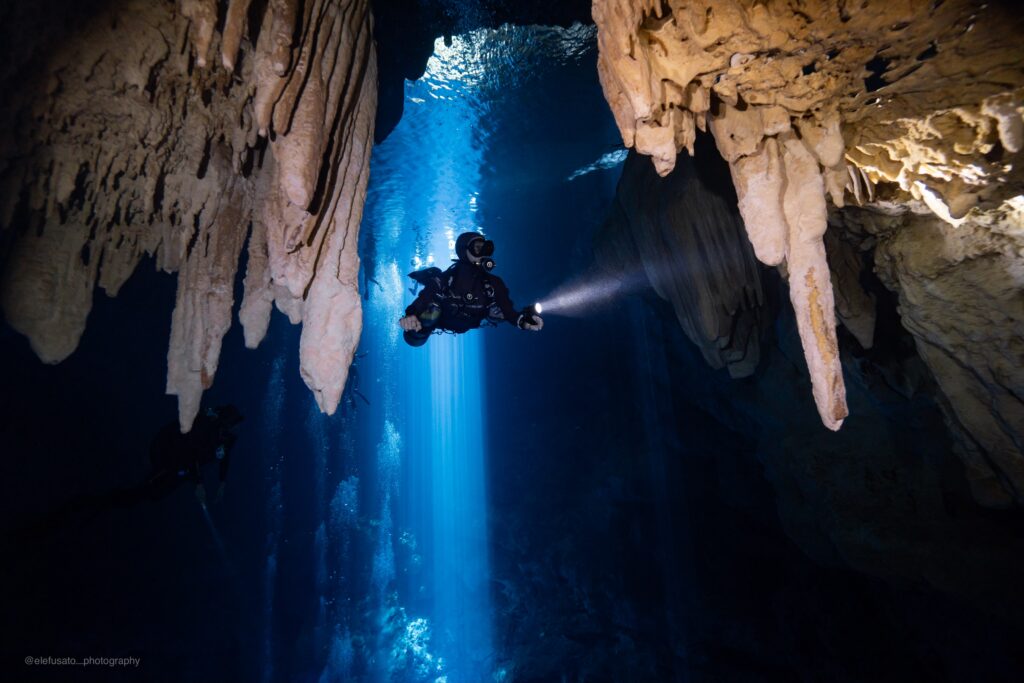
Because cavern diving and cave diving are two different activities.
During a recreational cenote dive, the route is selected to remain within the limits of the cavern zone.
This allows divers to experience exceptionally clear water, stalactites and stalagmites, huge natural chambers, spectacular light beams, haloclines and certain overhead passages without making a true cave penetration.
Having a ceiling above you does not automatically mean that you are cave diving.
Where does cave diving actually begin?
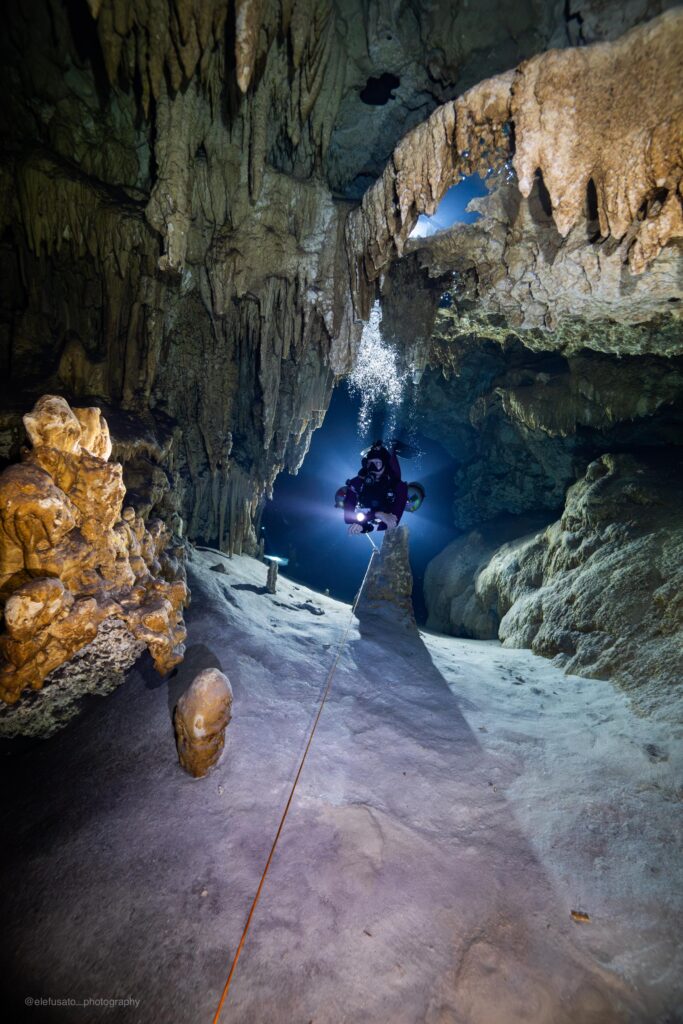
Now imagine that we continue farther.
The light from the entrance gradually fades and eventually disappears.
When we turn around, we can no longer see the outside. Ahead of us, the passage continues. It may divide into different directions, connect with other lines or lead toward exits located far from our starting point.
We are now inside the cave.
This is the world of cave diving.
The fixed 60-meter cavern-zone limit no longer applies. But that does not mean penetration becomes truly unlimited.
It is now determined by dive planning: available gas, consumption, depth, equipment configuration, navigation, conditions, experience and qualifications.
The cave may continue for kilometers. The diver always has limits.
Already cave certified? Discover our cave diving in the cenotes of Mexico.
Why is specific cave training essential?
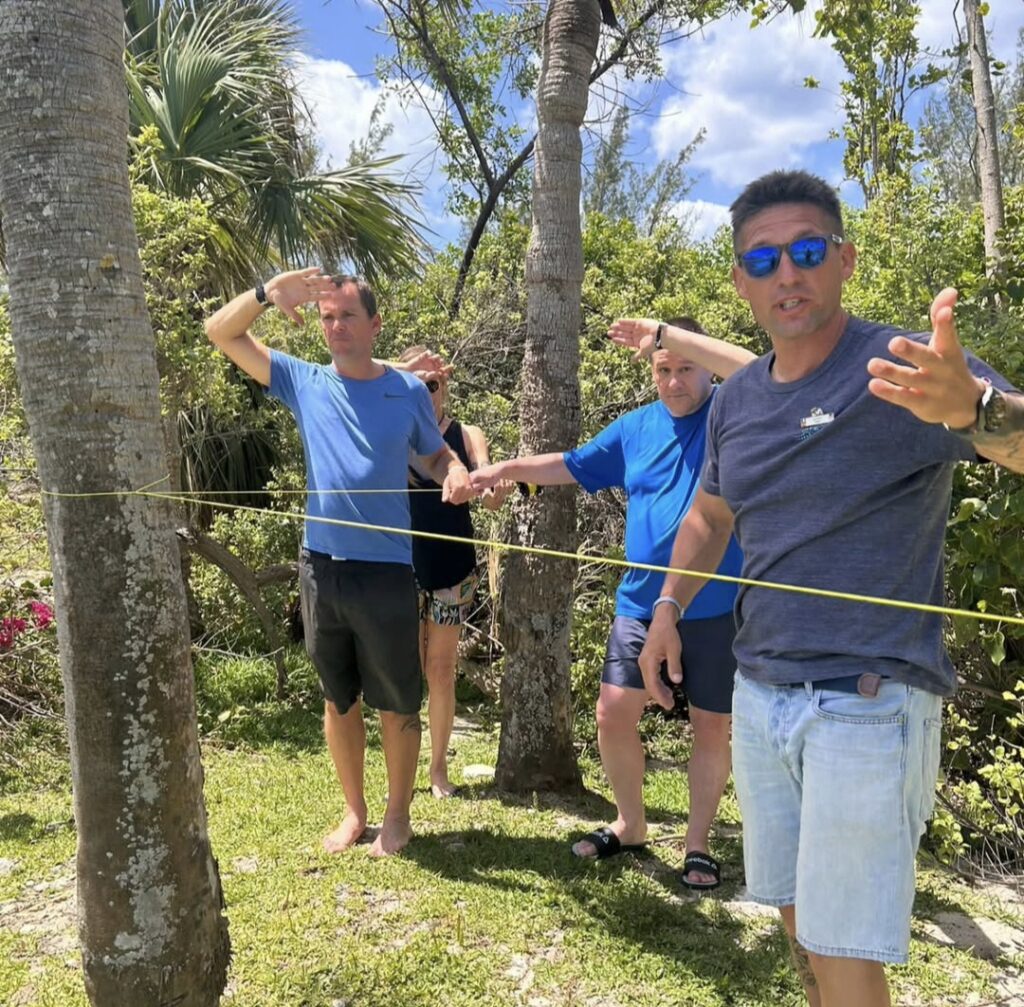
In open water, the surface is generally an option when a serious problem occurs.
In cave diving, that option disappears.
If an incident occurs several hundred meters from the entrance, it must be managed under the ceiling before the divers can travel the entire distance back to an exit.
Gas loss, light failure, loss of visibility, team separation or a navigation error can therefore have very different consequences.
Cave training is fundamentally about learning to prevent problems, manage them in an overhead environment and maintain the ability to reach an exit at all times.
The guideline: your reference to the exit
In an underwater cave system, the guideline is an essential reference.
Even when the water is exceptionally clear, fine particles or sediment can dramatically reduce visibility. In some situations, visibility can become virtually zero.
A cave diver must therefore be capable of following the line by touch, potentially while sharing gas with a teammate.
Inside a cave, the guideline is not simply a navigation tool.
It provides a continuous reference toward an exit.
Gas management changes too
In cave diving, the question is no longer simply:
“Do I have enough gas to continue?”
It becomes:
“If something happens now, do we have enough gas for the team to reach the exit?”
Under the IANTD Cave Diver standards used for training, gas management includes the Rule of Thirds.
However, this rule represents a planning limit, not an obligation to systematically consume an entire third of the available gas during penetration.
Conditions, depth, gas consumption and the complexity of the dive may always require a more conservative approach.
Cavern, Intro to Cave, Cave Diver: a progression
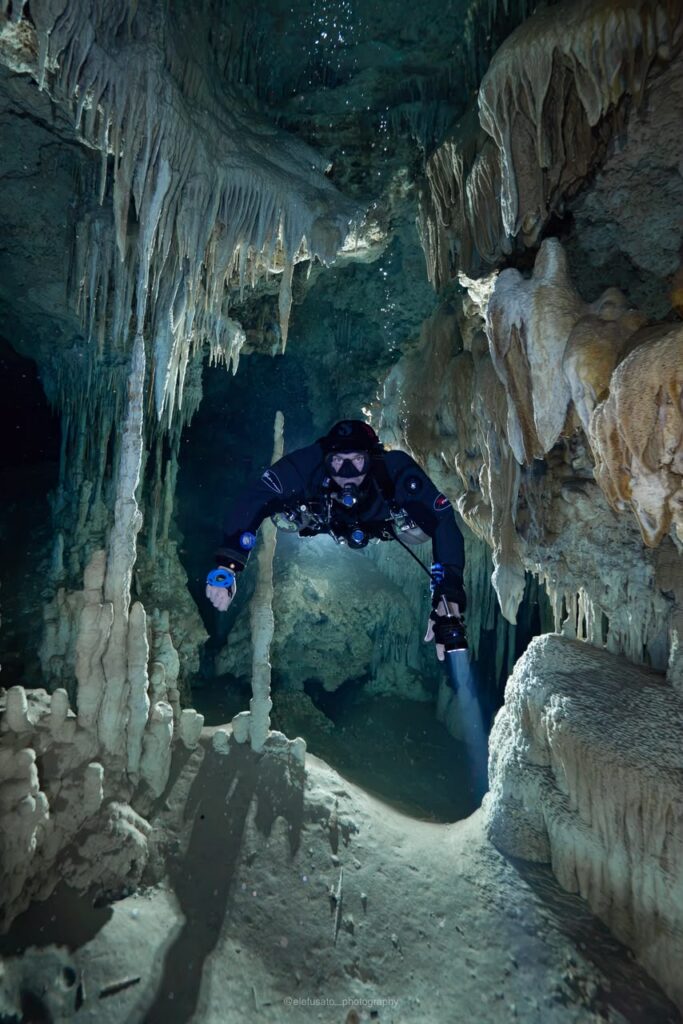
Cave diving is learned progressively.
Within the IANTD training pathway used by Halocline Explorers, the classic progression is:
Cavern Diver → Introductory Cave Diver → Cave Diver
Each level progressively increases the diver’s autonomy and the complexity of the dives.
Cavern Diver
The Cavern Diver course provides a structured introduction to overhead-environment diving.
Training includes guideline procedures, buoyancy, propulsion techniques, gas management and limited-visibility procedures.
IANTD standards require, among other elements, a minimum of 4 dives and 100 minutes of bottom time in an overhead environment.
At this level, an unobstructed exit and/or natural surface light remains visible.
→ Discover the IANTD Cavern Diver course
Introductory Cave Diver
With Introductory Cave Diver, the diver enters the true cave environment.
The exit no longer needs to remain visible, and penetration can extend beyond the limits of the cavern zone.
Navigation remains intentionally simple. Under the IANTD Introductory Cave Diver standards used by Halocline Explorers, jumps between different lines are not permitted at this level.
Depending on the applicable training pathway, the candidate must hold an appropriate prerequisite certification and have at least 30 logged dives.
→ Discover the IANTD Introductory Cave Diver course
Cave Diver
The IANTD Cave Diver level, commonly referred to as Full Cave among divers, introduces more complete underground navigation.
For the modular progression following Introductory Cave Diver, the standards include at least 50 logged dives, a minimum of 8 cave training dives and at least 400 minutes of cave bottom time.
The course further develops dive planning and introduces navigation techniques including gaps, traverses and circuits.
→ Discover the IANTD Cave Diver course in Playa del Carmen
Cave Diver does not mean “anything goes”
A Cave Diver certification represents a level of training. It does not replace experience, nor does it automatically qualify a diver for every form of underground diving.
Certain dives require additional skills, experience or training: stages, DPVs, cave sidemount, CCR, advanced decompression or other forms of exploration.
Certification defines what you have learned. Experience shapes the diver you become.
Cavern and cave: two ways to discover the same world
You absolutely do not need to become a Cave Diver to enjoy Mexico’s cenotes.
A cavern dive can already be an extraordinary experience: beams of sunlight, huge natural chambers, limestone formations, crystal-clear water and haloclines.
Cave diving simply opens another door.
The one beyond the light.
You gradually leave the large natural openings behind and enter the true underground rivers of the Yucatán.
These are not simply two different levels of difficulty.
They are two different ways of discovering the same underground world.
Which experience should you choose?
If you are a recreational diver visiting Playa del Carmen and want to discover the cenotes, you do not need to be a Cave Diver.
Your dive simply needs to be appropriate for your certification, experience and actual comfort level in the water.
→ Discover cenote diving in Playa del Carmen
But after a few cenote dives, a question sometimes begins to emerge:
“What is beyond there?”
Beyond the light. Beyond the line that continues. Beyond the point where your dive ends.
That is often where an interest in cave diving begins.
The progression Cavern → Introductory Cave → Cave Diver provides a structured path to gradually develop the skills needed to go farther.
→ Discover our Cave Diving courses in Mexico
Frequently asked questions about cavern and cave diving
Is cenote diving always cave diving?
No. Many cenote dives accessible to recreational divers remain within the cavern zone. Cave diving begins when the limits of that environment are exceeded.
What is the maximum cavern-diving distance in Mexico?
A maximum of 60 meters to an exit.
Can I have a ceiling above me without being a Cave Diver?
Yes. This is precisely what can happen within the cavern zone. Having a ceiling overhead does not automatically mean you are cave diving.
Can a Cave Diver penetrate an unlimited distance?
No. The fixed 60-meter cavern-zone limit no longer applies, but penetration remains limited by gas, depth, navigation, equipment configuration, experience and team planning.
What training do I need for cave diving?
Within the IANTD progression presented here, the classic pathway is Cavern Diver → Introductory Cave Diver → Cave Diver.
Is Intro to Cave already cave diving?
Yes. Introductory Cave allows the diver to enter the true cave environment within the specific limits of that certification.
Do I have to dive sidemount?
No. Sidemount is extremely common in the caves of the Yucatán, but other appropriate configurations can be used when the diver has the corresponding training.
Discover the cenotes or start cave diving in Mexico
Whether your goal is to experience your first cenote dives or begin formal cave diving training, the most important thing is to choose an experience appropriate for your current level.
Halocline Explorers offers cenote diving and Cavern Diver, Introductory Cave Diver and Cave Diver training in Playa del Carmen and the Riviera Maya, with progression adapted to your experience and goals.
Not sure which level is right for you? Tell us your current certification, number of logged dives and previous cenote experience, and we can help you determine which dive or training level best matches your experience.
→ Explore all IANTD Cave Diving courses in Mexico