
IANTD Technical Diver Course in Mexico
Develop the skills required to plan and conduct technical dives with mandatory decompression to a maximum training depth of 55 metres / 180 feet.
The IANTD Technical Diver course develops advanced gas management, the use of two decompression cylinders, emergency procedures and effective teamwork.
Training can be completed in either manifolded doubles or a sidemount configuration.
✔ Maximum training depth of 55 metres / 180 feet
✔ Two decompression gases
✔ Training in doubles or sidemount
✔ Training with an IANTD Instructor Trainer
✔ Available in English, French or Spanish
Technical Diver Course: Essential Information
Certification: IANTD Technical Diver
Maximum depth: 55 metres / 180 feet
Minimum number of dives: 4
Minimum open-water runtime: 220 minutes
Dives deeper than 40 metres: minimum 2
Mandatory decompression: yes
Decompression gases: EANx or oxygen
Decompression cylinders: 2 per diver
Configuration: manifolded doubles or sidemount
Main prerequisite: Advanced EANx Diver
Minimum experience: 100 logged dives
Price: from MXN 5,000 per day
Languages: English, French or Spanish
The final course duration depends on your experience, equipment configuration, progression and diving conditions.
What Is the IANTD Technical Diver Course?
The IANTD Technical Diver course prepares divers to plan and conduct technical dives between 30 and 55 metres with mandatory decompression.
It develops an advanced understanding of custom EANx mixtures, their operating limits and the use of EANx or oxygen during decompression.
The program uses two decompression cylinders, allowing the diver to optimize the ascent and develop the ability to manage multiple breathing gases during the same dive.
Depth, however, is only one part of Technical Diver training.
The program places particular emphasis on:
- dive planning;
- gas management;
- equipment redundancy;
- stability while performing procedures;
- equipment-failure management;
- communication;
- teamwork.
Who Is the Technical Diver Course For?
This course is designed for divers who already have decompression-diving experience and want to:
- progress beyond Advanced EANx Diver;
- use two decompression gases;
- conduct technical dives to a maximum training depth of 55 metres;
- improve dive planning;
- develop more advanced gas-management skills;
- refine buoyancy and trim;
- practise advanced emergency procedures;
- become more effective within a technical-diving team;
- prepare for future Trimix training;
- use a technical doubles or sidemount configuration.
This course is not an introduction to technical diving.
Candidates should already have a solid understanding of decompression procedures and sufficient deep-diving experience.
Technical Diver Course Prerequisites
According to the IANTD standards used for this program, candidates must:
- be at least 18 years old;
- hold an IANTD Advanced EANx Diver certification or equivalent;
- have at least 100 logged dives;
- have completed at least 30 dives deeper than 27 metres / 90 feet.
Your certifications and dive log are reviewed before the program is confirmed.
An evaluation dive may be required when your recent experience, equipment configuration or mastery of the necessary skills needs to be assessed.
Course Objectives
The objective of the Technical Diver course is to teach you how to plan and conduct deeper technical dives involving mandatory decompression, multiple gases and a fully redundant equipment configuration.
You will learn how to:
- select appropriate breathing gases;
- analyze and identify each gas;
- calculate maximum operating depths;
- plan a deep technical dive;
- calculate gas consumption and reserves;
- determine team gas requirements;
- use two decompression cylinders;
- organize and verify gas switches;
- conduct an ascent with multiple decompression stops;
- prepare contingency plans;
- manage the loss of a breathing gas;
- respond to regulator failures;
- perform valve shutdowns;
- share gas during an ascent;
- deploy a surface marker buoy;
- maintain precise trim while performing procedures;
- coordinate team actions;
- assist a diver in difficulty.
Technical Diver Course Structure
The program consists of three complementary components.
Theory and Dive Planning
Theory sessions cover topics including:
- physiology of deep diving;
- decompression;
- use of custom EANx mixtures;
- oxygen-exposure limits;
- gas planning;
- RMV calculations;
- gas matching;
- selection of decompression gases;
- decompression-stop planning;
- contingency planning;
- team procedures;
- incident management;
- risk analysis.
Every dive is planned by the team.
Divers must understand the decisions made during planning and be capable of adapting the plan when conditions require it.
Confined-Water Training
Confined-water sessions allow us to evaluate your configuration and practise procedures before progressing to deeper dives.
You will work on:
- equipment checks;
- buoyancy;
- trim;
- propulsion techniques;
- valve shutdowns;
- decompression-cylinder handling;
- gas sharing;
- gas switches;
- responding to a loss of buoyancy;
- using an SMB as a secondary buoyancy system;
- equipment removal and replacement.
Depth and complexity increase only when the fundamental skills have been mastered.
Open-Water Training Dives
According to the IANTD standards used for this program, training includes at least:
- four dives;
- 220 minutes of open-water runtime;
- two dives deeper than 40 metres / 130 feet;
- decompression using EANx or oxygen;
- two decompression cylinders per diver.
All dives are conducted as a single team.
Communication, team cohesion and the ability to collectively manage abnormal situations are integral parts of the evaluation.
Training progresses within the program limits, with dive planning, equipment management and decompression procedures adapted to each dive.
Gas and Decompression Planning
Technical Diver training develops a more comprehensive approach to planning than the Advanced EANx level.
The diver must be able to determine:
- gas required for the bottom portion of the dive;
- individual gas consumption;
- team reserves;
- the appropriate turn or ascent point;
- suitable decompression gases;
- maximum operating depth for each gas;
- gas volumes required for decompression;
- available options if a decompression gas is lost;
- the impact of exceeding planned depth or bottom time.
Every member of the team must understand both the primary plan and contingency procedures before entering the water.
Using Two Decompression Gases
During the course, each diver carries two decompression cylinders containing EANx or oxygen.
You will learn how to:
- analyze each breathing gas;
- clearly label the cylinders;
- verify cylinder pressure;
- determine maximum operating depth;
- correctly position regulators;
- identify the correct gas before each switch;
- perform cross-checks with the team;
- manage the loss of a decompression gas;
- adapt decompression when necessary;
- maintain precise depth during gas switches.
Using multiple gases can improve decompression options, but it also increases the consequences of breathing the wrong gas.
Gas identification and verification procedures are therefore a central part of the course.
Equipment Configuration Used During Training
Two configurations are permitted by the IANTD standards used for this program.
Manifolded Doubles
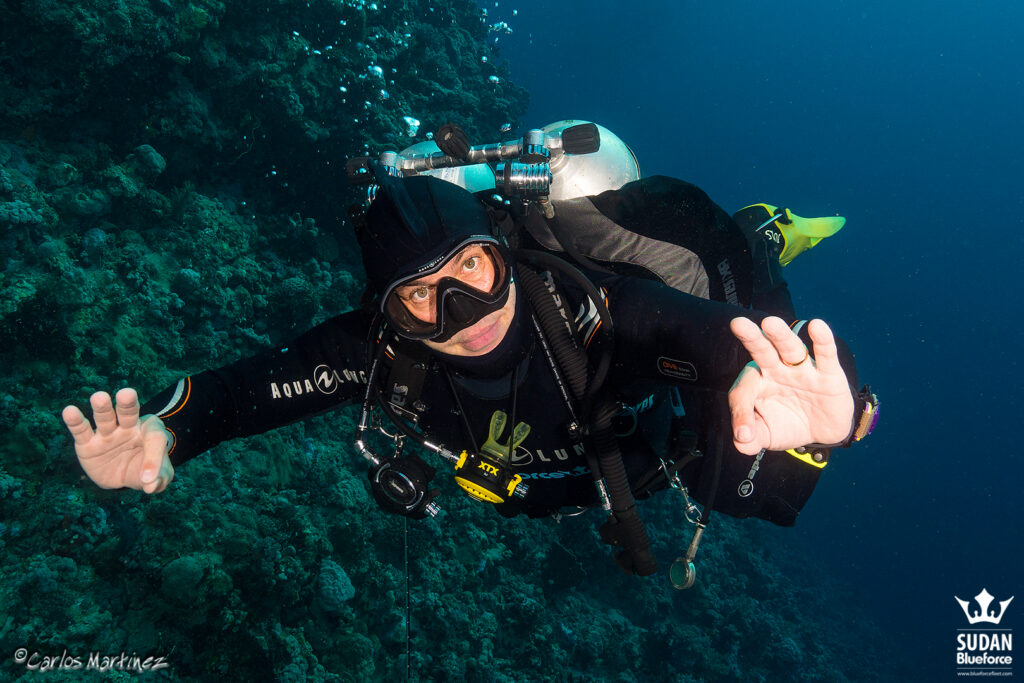
The configuration consists of two cylinders connected by a manifold with two independent valves, together with an appropriate wing, harness and regulator configuration.
Sidemount
The two primary cylinders are positioned along the diver’s sides and managed independently.
In either configuration, the diver must also carry two decompression cylinders.
The equipment must provide:
- complete redundancy;
- access to cylinder valves;
- effective gas sharing;
- clear regulator identification;
- organized decompression-cylinder management;
- stable trim;
- precise equipment handling during procedures.
Your configuration is inspected before the program begins.
Changes may be required if any component compromises safety or prevents procedures from being performed correctly.
Practical Skills Developed During the Course
The program includes skills such as:
- swimming with a complete technical-diving configuration;
- precise buoyancy control;
- maintaining horizontal trim;
- valve shutdowns;
- managing a first-stage leak;
- managing a free-flowing regulator;
- long-hose gas sharing;
- extended swimming while sharing gas;
- locating and assisting a teammate;
- responding to gas loss;
- handling decompression cylinders;
- gas switches;
- removing and replacing a decompression cylinder;
- deploying a surface marker buoy;
- using the SMB as an ascent reference;
- calculating RMV;
- gas matching;
- responding to loss of buoyancy;
- assisting an unconscious diver.
All procedures must be performed while maintaining acceptable buoyancy, depth control and situational awareness.
Is Technical Diver a Trimix Course?
No.
The IANTD Technical Diver certification develops the use of custom EANx mixtures and the use of EANx or oxygen during decompression.
It is not a Trimix certification.
To use breathing mixtures containing helium beyond qualifications already held, the diver must complete an appropriate Trimix program, such as Normoxic Trimix Diver.
Technical Diver nevertheless provides an excellent foundation for progressing toward more advanced Trimix training.
What Comes After Technical Diver?
After certification and after developing the necessary experience, several training pathways are possible:
- Normoxic Trimix Diver;
- Normoxic Trimix Plus Diver;
- Trimix Diver;
- Technical Sidemount Diver;
- Technical Wreck Diver;
- advanced technical-diving programs;
- selected cave-diving programs;
- rebreather training appropriate to your experience.
The most appropriate progression depends on your objectives, equipment configuration and the environments in which you want to dive.
Why Take Your Technical Diver Course in Mexico?
Playa del Carmen and the Riviera Maya provide access to different environments suitable for developing depth, decompression and technical-diving procedures.
Varied Dive Sites
Sites are selected according to:
- required depth;
- objectives of each training session;
- equipment configuration;
- weather conditions;
- diver experience;
- gas logistics.
Conditions Suitable for Training
Water temperature and visibility at many sites allow more attention to be focused on planning, equipment and procedures.
Personalized Progression
The program is not designed simply to reach a particular depth.
Every training session has specific educational objectives and progression is adapted accordingly.
Why Choose Halocline Explorers?
IANTD Instructor Trainer
Your training is conducted by Julien Garnier, IANTD Instructor Trainer and Technical Diver Instructor.
Small Groups
The number of participants is limited to improve observation, correction and repetition of procedures.
Training in Three Languages
The program can be taught in English, French or Spanish.
Technical Diving Experience
Instruction is supported by practical experience in deep diving, decompression, sidemount, Trimix, rebreather and cave diving.
Skills-Based Certification
Completing the minimum number of dives does not automatically guarantee certification.
Candidates must demonstrate mastery of the required knowledge, planning and practical procedures.
Technical Diver Course Price
From MXN 5,000 per Day
The final price depends on factors including:
- number of training days required;
- equipment configuration;
- breathing gases;
- two decompression gases;
- cylinders required;
- available equipment;
- dive-site entrance fees;
- training and certification fees.
A personalized quote is prepared after reviewing your current level, equipment and objectives.
Frequently Asked Questions About the Technical Diver Course
What Is the Maximum Depth of the Course?
The course progresses within the training limits and according to environmental conditions.
How Many Dives Are Included in the Program?
The program requires at least four dives and 220 minutes of open-water runtime.
How Many Dives Are Conducted Deeper Than 40 Metres?
At least two dives must be conducted deeper than 40 metres / 130 feet.
What Is the Main Prerequisite?
You must hold an Advanced EANx Diver certification or equivalent.
How Many Logged Dives Do I Need?
You must have at least 100 logged dives, including at least 30 dives deeper than 27 metres / 90 feet.
How Many Decompression Cylinders Are Used?
Each diver must carry two decompression cylinders with sufficient gas for the planned dive.
Which Gases Are Used for Decompression?
Decompression stops are conducted using EANx or oxygen, according to the planned dive.
Can I Take the Technical Diver Course in Sidemount?
Yes.
IANTD standards allow the program to be completed using either a sidemount configuration or manifolded doubles.
Is Technical Diver a Trimix Certification?
No.
The program primarily covers custom EANx mixtures and the use of EANx or oxygen during decompression.
Does the Course Always Take a Fixed Number of Days?
No.
The standards establish minimum numbers of dives, runtime and required skills.
The number of training days depends on progression, logistics and diving conditions.
Is Certification Guaranteed?
No.
Certification is awarded after the required knowledge, planning and practical skills have been successfully demonstrated.
Can I Take the Course in English?
Yes.
The entire program can be taught in English, French or Spanish.
Ready to Become an IANTD Technical Diver?
This course will strengthen your dive planning, equipment control and decompression procedures so you can develop greater autonomy in technical diving.
To receive a personalized program, send us:
- your current certifications;
- number of logged dives;
- recent dives deeper than 27 metres;
- decompression-diving experience;
- current equipment configuration;
- training objectives;
- travel dates in Playa del Carmen.




