
IANTD CCR Cave Diver Course in Mexico
Learn to plan and conduct rebreather cave dives with an IANTD CCR Cave Diver course in the cenotes of the Riviera Maya.
The Triton is the primary rebreather used and promoted for CCR Cave training at Halocline Explorers. Training can also be conducted on JJ-CCR or Optima for divers who are already certified and experienced on the unit they will use.
✔ IANTD CCR Cave training in the cenotes of Mexico
✔ Triton, JJ-CCR and Optima
✔ Small groups and personalized progression
✔ Training available in English, French or Spanish
Request an Evaluation of My Current Level
CCR Cave Course: Essential Information
Course: IANTD CCR Cave Diver
Location: Playa del Carmen and the cenotes of the Riviera Maya
Rebreathers currently accepted: Triton, JJ-CCR and Optima
Normal maximum training depth: 40 metres / 130 feet
Minimum age: 18
Maximum group size: 3 students per instructor
Price: from MXN 6,000 per day
Duration: depends on previous training, certifications and experience
Languages: English, French or Spanish
The final price depends on the number of training days, cenote entrance fees, breathing gases, scrubber material, bailout requirements and equipment needed.
Moving from Open-Circuit Cave Diving to CCR Cave
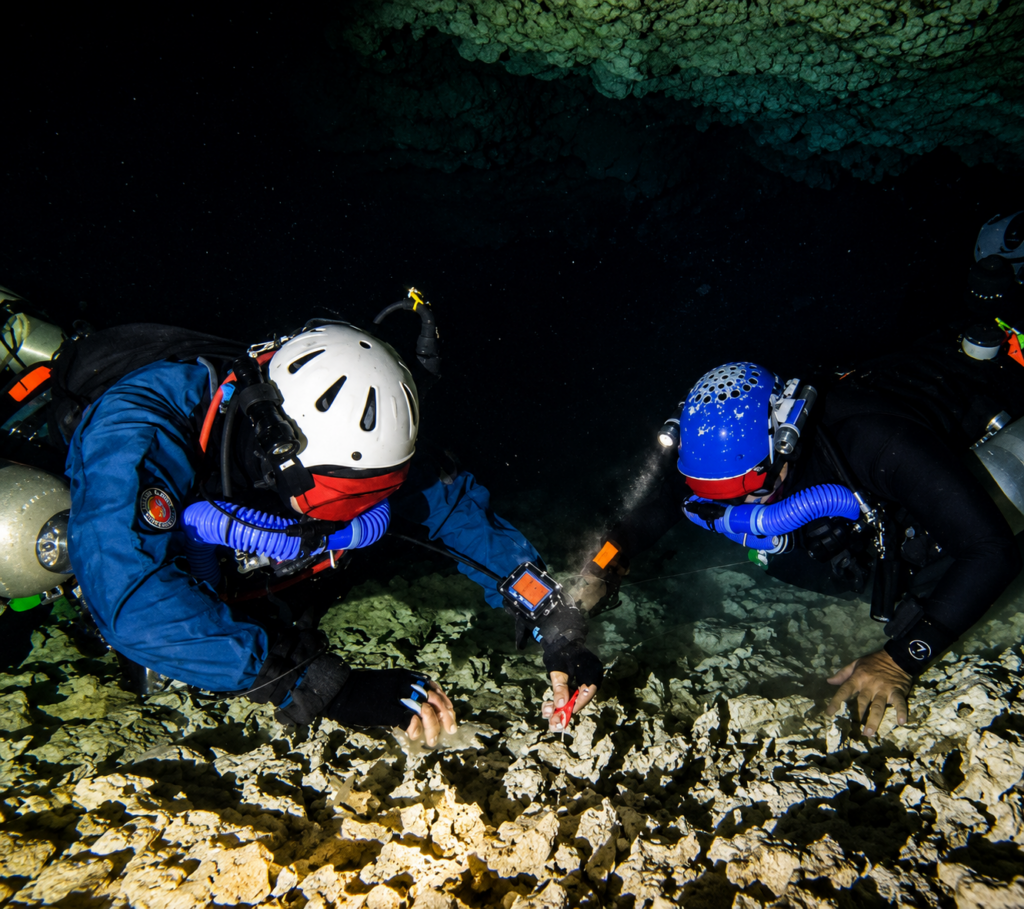
CCR fundamentally changes the way a cave dive is planned.
Its efficient gas use and low bubble production make long and discreet dives possible, but they also introduce additional constraints.
Penetration distance is never determined solely by the theoretical endurance of the rebreather.
It remains limited by the amount of bailout gas required to allow the diver to reach the exit on open circuit in the event of a complete rebreather failure.
CCR Cave training therefore develops several areas simultaneously:
- cave-diving skills;
- mastery of the rebreather being used;
- bailout planning;
- rebreather-resource management;
- emergency procedures specific to an overhead environment.
This course does not teach you how to use a new rebreather.
You must already be certified and sufficiently experienced on the unit used during training.
CCR Cave Training on Triton
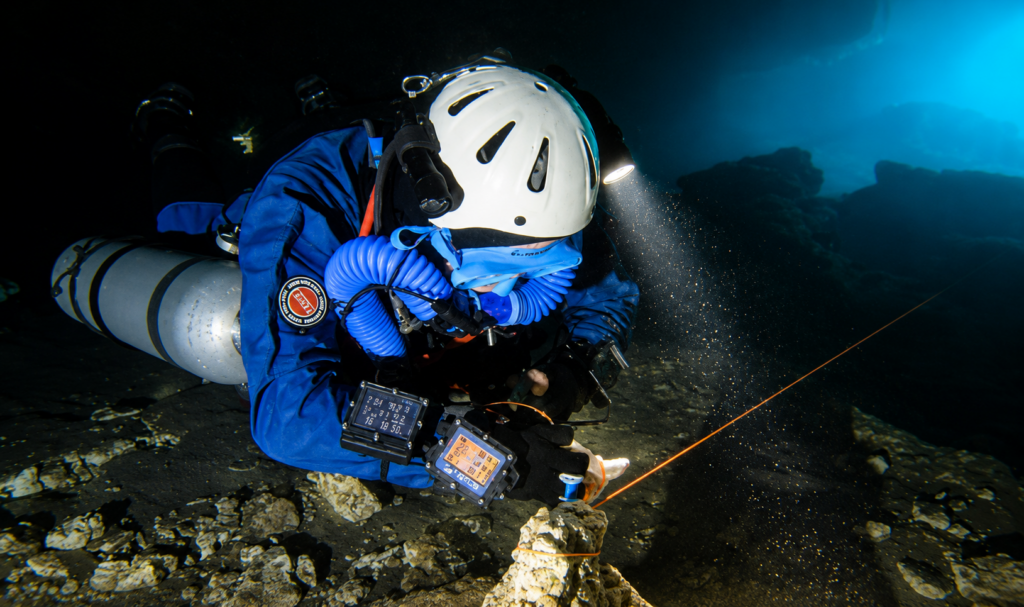
The Triton is the primary rebreather used for CCR Cave training offered by Halocline Explorers.
This chest-mounted manual closed-circuit rebreather can be integrated into different equipment configurations.
It allows divers to retain a familiar sidemount or backmount configuration while adding the advantages of closed-circuit diving.
CCR Cave training on the Triton further develops:
- manual PPO₂ management;
- access to the controls and components of the unit;
- bailout configuration;
- oxygen and diluent management;
- complete loop-loss procedures;
- transition to open circuit;
- exiting the cave on bailout;
- integration of the Triton into a cave-diving configuration;
- management of additional cylinders;
- maintaining trim in an overhead environment.
Divers must hold the appropriate CCR certification on the Triton and meet the experience requirements for their specific entry pathway.
Discover CCR Triton Training
CCR Cave Training on JJ-CCR
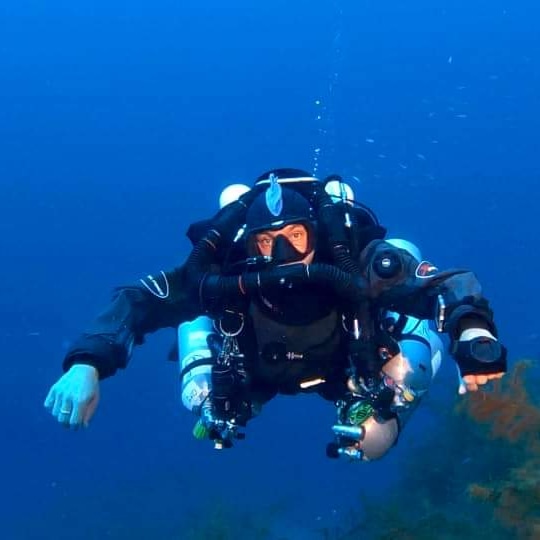
CCR Cave training can also be completed on the JJ-CCR by divers who are already certified and experienced on this unit.
Training then focuses on integrating the JJ-CCR into cave diving, including:
- bailout configuration and positioning;
- open-circuit exit planning;
- cell and PPO₂ management;
- response to unit alarms and anomalies;
- management of oxygen or diluent loss;
- buoyancy control in an overhead environment;
- navigation and team procedures;
- zero-visibility exits;
- management of an unusable breathing loop.
Halocline Explorers does not provide initial JJ-CCR user training.
Divers must arrive with a valid user certification on the JJ-CCR and sufficient experience on the unit.
CCR Cave Training on Optima
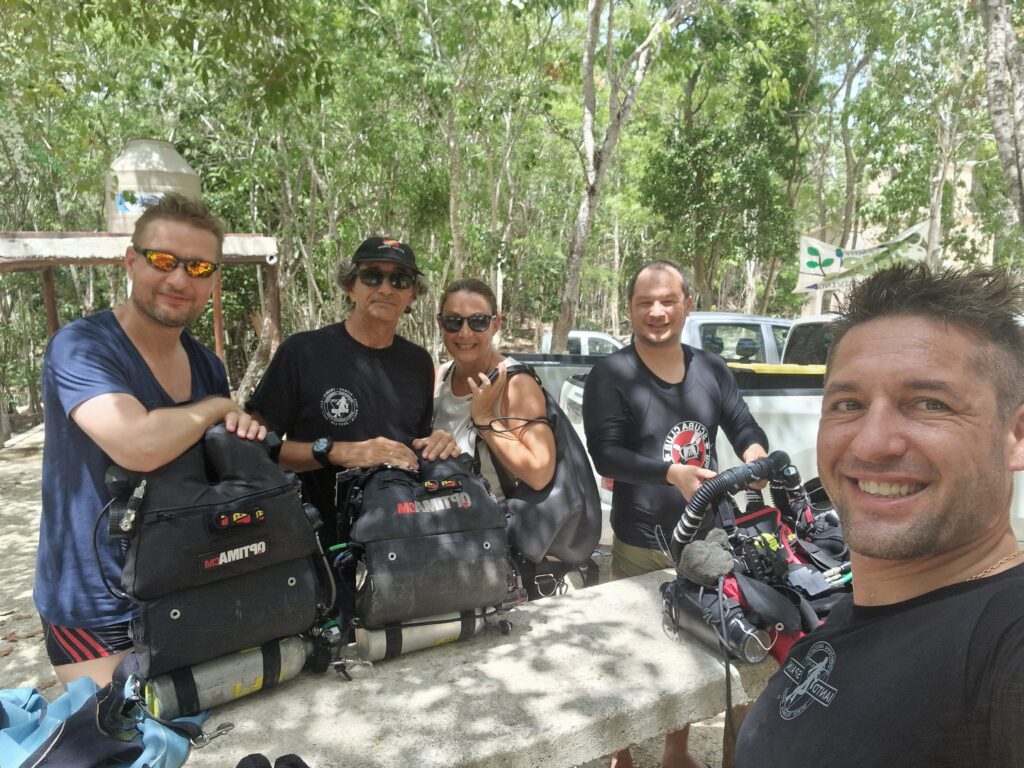
CCR Cave training is also available on the Optima for divers who already hold the required certification and experience on this unit.
The program focuses on using the Optima in an overhead environment, including:
- unit preparation and verification;
- bailout integration;
- resource planning;
- PPO₂ monitoring;
- response to unit anomalies;
- transition to open circuit;
- buoyancy control;
- cave navigation;
- lost-line and zero-visibility procedures;
- exiting the cave with a failed rebreather.
Initial Optima user training is not offered.
CCR Cave training on the Optima is available only to divers who are already qualified and sufficiently experienced on this unit.
Additional Rebreathers May Be Offered in the Future
Halocline Explorers intends to progressively expand the range of rebreathers available for CCR Cave training.
The KISS Sidewinder 2 is one of the units being considered for the future. However, it is not currently offered for training.
Its future addition will depend on factors including:
- availability of the unit;
- recognition for the relevant training program;
- manufacturer requirements;
- specific instructor qualification;
- compliance with applicable IANTD standards.
No Sidewinder 2 training will be advertised as available until all applicable conditions have been met.
Rebreathers currently available for CCR Cave training: Triton, JJ-CCR and Optima only.
IANTD CCR Cave Diver Course Prerequisites
Entry requirements depend on the diver’s previous certifications.
Modular Pathway After RCCR Introductory Cave Diver
The diver must notably:
- be at least 18 years old;
- hold an RCCR Introductory Cave Diver certification or equivalent;
- hold a CCR Advanced EANx Diver certification or equivalent;
- have at least 50 rebreather dives.
CCR Advanced EANx training cannot be completed concurrently with the CCR Cave Diver course.
Entry Without an RCCR Introductory Cave Diver Certification
The diver must notably:
- be at least 18 years old;
- hold a CCR Advanced EANx Diver certification or equivalent;
- have at least 100 rebreather dives.
This pathway requires a longer training program because it must incorporate cave-diving skills that would normally have been developed at the introductory level.
Open-Circuit Cave Diver to CCR Cave Crossover
An open-circuit Cave Diver must notably:
- hold a CCR Advanced EANx Diver certification or equivalent on the unit being used;
- have at least 25 rebreather dives;
- have at least 50 hours of experience on that rebreather;
- demonstrate sufficient mastery of both the rebreather and open-circuit cave-diving procedures.
Certifications, dive logs and recent experience are reviewed before enrollment is confirmed.
CCR Cave Course Structure
The duration depends on the diver’s previous training pathway.
Without a Rebreather Introductory Cave Diver Certification
The program includes at least:
- theory sessions;
- land drills;
- one or more confined-water sessions;
- 10 CCR cave dives;
- 600 minutes of cave bottom time.
With a Rebreather Introductory Cave Diver Certification
The program includes at least:
- 6 CCR cave dives;
- 360 minutes of cave bottom time;
- validation of all required CCR Cave skills.
Open-Circuit Cave Diver to CCR Cave Crossover
The crossover includes at least:
- one confined-water session;
- 2 CCR cave dives;
- 200 minutes of cave bottom time;
- completion of all CCR Cave-specific procedures.
A crossover is not simply an administrative formality.
All skills specific to CCR cave diving must be demonstrated.
A Training Program Using Multiple Cenotes
When environmental conditions allow, the IANTD standards used for this program call for training in at least three different caves during the CCR Cave course.
This variety allows training in different environments, including:
- large passages;
- changing depths;
- areas with haloclines;
- highly decorated passages;
- simple navigation progressing toward more complex routes;
- environments requiring different propulsion techniques.
Sites are selected for their educational value rather than simply for difficulty or appearance.
Skills Developed During CCR Cave Training
Bailout Planning
You will learn to calculate the amount of gas required to return to the exit in the event of a complete rebreather failure.
Planning takes into account:
- penetration distance;
- depth;
- decompression;
- gas consumption under stress;
- gas available within the team;
- characteristics of the cave;
- additional cylinders when required.
Rebreather Management in an Overhead Environment
You will develop the management of oxygen, diluent, scrubber duration and PPO₂ during cave dives.
The rule of thirds applies to oxygen, diluent or scrubber duration, depending on which limit is reached first.
Penetration must also remain within the exit capability provided by the available bailout gas.
Emergency Procedures
Training includes exercises involving:
- hypoxia;
- hyperoxia;
- hypercapnia;
- oxygen loss;
- diluent loss;
- oxygen-cell anomalies;
- electronic failure;
- flooded loop;
- complete rebreather failure;
- transition to bailout;
- open-circuit exit;
- sharing and passing bailout cylinders;
- semi-closed bailout procedures.
Cave Navigation
You will develop the use of guidelines and markers required for cave navigation.
Exercises include:
- guideline placement and use;
- directional and personal markers;
- intersection management;
- lost-line procedures;
- lost-diver procedures;
- line interruptions or breaks;
- zero-visibility exits;
- touch communication.
Buoyancy, Trim and Propulsion
Excellent buoyancy control is essential to protect cave formations and prevent sediment disturbance.
Training develops:
- horizontal trim;
- cave propulsion techniques;
- precise stops;
- backward movement;
- controlled turns;
- cylinder handling without depth changes;
- breathing-loop volume management;
- buoyancy control while performing procedures.
Main CCR Cave Training Limits
Under normal program conditions:
- maximum depth is 40 metres / 130 feet;
- the diver must remain within the exit capability of the available bailout;
- maximum CCR PPO₂ is 1.3 during the active portion of the dive;
- PPO₂ may reach 1.4 during decompression;
- diluent must be appropriate for the planned depth;
- resources are managed according to the rule of thirds;
- each team must carry an appropriate amount of bailout gas;
- three different caves are used when conditions allow;
- maximum ratio is three students per instructor inside the cave.
These limits do not replace the specific planning required for each dive.
Why Take Your CCR Cave Course in Mexico?
The Riviera Maya contains some of the world’s most extensive flooded cave systems.
The variety of cenotes allows a training progression to be adapted to each diver’s experience and rebreather configuration.
Exceptional Visibility
The clarity of the water makes it easier to observe trim, propulsion techniques and equipment management.
Highly Varied Cave Systems
The cenotes provide sufficiently different passages, depths and configurations to develop broader cave-diving experience.
Conditions Well Suited to Training
Many sites have little current, allowing greater attention to be dedicated to skills, navigation and procedures.
A Strong Cave-Diving Culture
The Riviera Maya has an international community of divers, instructors and explorers specializing in cave diving and CCR cave diving.
Why Choose Halocline Explorers?
Triton at the Core of Our CCR Cave Training
The Triton is the primary rebreather used in our CCR Cave courses.
Training is supported by extensive experience using this unit in technical and cave-diving environments.
JJ-CCR and Optima Also Accepted
Divers who are already certified and experienced on these units can complete their CCR Cave training on a JJ-CCR or Optima.
Personalized Training
The program is built around:
- your cave certification;
- your CCR level;
- your experience on the unit;
- number of recent dives;
- equipment configuration;
- training objectives.
Small Groups
Small groups allow more time for skill correction, dive planning and individual progression.
Training in Three Languages
The course can be taught in English, French or Spanish.
Skills-Based Certification
Certification is not automatically awarded after a predetermined number of days.
All knowledge and skills required by the program must be demonstrated.
Frequently Asked Questions About CCR Cave Training in Mexico
What Is CCR Cave Diving?
CCR Cave diving combines cave diving with a closed-circuit rebreather.
It combines cave-diving skills with the procedures, gas management and specific risks associated with CCR diving.
Which Rebreathers Can I Use for the Course?
CCR Cave training is currently available on Triton, JJ-CCR and Optima.
Is the Triton Your Primary Rebreather?
Yes.
The Triton is the primary rebreather used and promoted by Halocline Explorers for CCR Cave training and diving.
Do You Offer CCR Cave Training on the Sidewinder 2?
Not currently.
The KISS Sidewinder 2 is one of the units being considered for the future. Its addition will depend on instructor qualifications, applicable standards, manufacturer requirements and unit availability.
Do I Already Need to Be Certified on My Rebreather?
Yes.
CCR Cave training does not replace rebreather user training.
You must already be certified and experienced on the Triton, JJ-CCR or Optima you will use during the course.
Can I Learn to Use the JJ-CCR or Optima During This Course?
No.
Halocline Explorers does not offer initial JJ-CCR or Optima user training.
These units are accepted only for CCR Cave training with divers who are already appropriately qualified.
Do I Already Need to Be a Cave Diver?
Not necessarily for every pathway.
However, without an Introductory Cave or Cave Diver certification, the training program is longer.
Your exact pathway depends on your existing CCR and cave-diving certifications.
What Is the Maximum Training Depth?
The normal maximum depth for the CCR Cave program is 40 metres / 130 feet.
Actual depth depends on the educational objectives, diver certification and conditions.
How Many Dives Are Required?
It depends on the pathway:
- 10 dives and 600 minutes without Rebreather Introductory Cave certification;
- 6 dives and 360 minutes with that certification;
- 2 dives and 200 minutes for an open-circuit Cave Diver crossover, plus a confined-water session.
How Long Does CCR Cave Training Take?
The number of days depends on the pathway, required dive times, conditions and individual progression.
A personalized schedule is prepared after reviewing your experience and certifications.
Is Bailout Mandatory?
Yes.
Planning and carrying sufficient bailout gas to reach the exit is one of the fundamental elements of CCR cave diving.
What Equipment Do I Need to Bring?
You must have a properly maintained rebreather, the appropriate user certification for that unit and a configuration suitable for cave diving.
The complete equipment list is reviewed before training.
Is the Course Available in English?
Yes.
CCR Cave training can be taught in English, French or Spanish.
Ready to Start Your CCR Cave Training in Mexico?
Send us the following information so we can prepare a program adapted to your experience:
- your CCR certifications;
- rebreather model;
- number of dives and hours on that unit;
- cave-diving certifications;
- number of cave dives;
- recent diving experience;
- training objectives;
- travel dates in Mexico.




