
IANTD Cave Diver Course in Playa del Carmen
Become a qualified Cave Diver and learn to plan and conduct complete cave dives in the extraordinary flooded cave systems of the Riviera Maya.
The IANTD Cave Diver course in Playa del Carmen, also commonly searched for as a Full Cave Diver course, develops the skills required to dive in caves, manage more complex navigation and respond to a wide range of emergencies in an overhead environment.
You will work on gas management, zero-visibility exits, regulator failures, lost-line procedures, lost-diver searches and the main forms of underwater cave navigation.
Modular pathway after Introductory Cave: minimum 8 dives and 400 minutes of cave bottom time
Pathway without Introductory Cave: minimum 12 dives and 500 minutes of cave bottom time
Minimum experience: 50 or 100 logged dives depending on the pathway
Usual maximum depth: 45 metres / 150 feet
Gas management: rule of thirds
Configuration: doubles or sidemount
Price: from MXN 5,000 per day
Certification: IANTD Cave Diver
Languages: English, French or Spanish
Become a Cave Diver in the Cenotes of Mexico
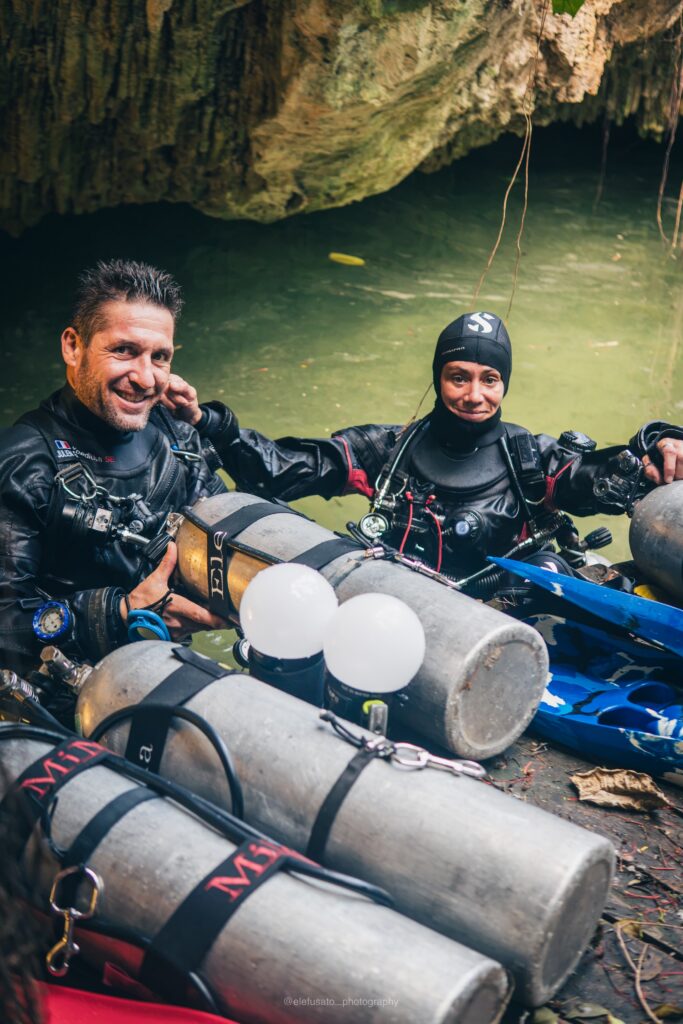
The Cave Diver certification represents a major milestone in the progression of an overhead-environment diver.
It teaches you how to plan and conduct cave dives using a redundant equipment configuration, a continuous guideline and procedures adapted to an environment where a direct ascent to the surface is impossible.
Unlike a Cavern Diver, a Cave Diver is not restricted to the zone illuminated by natural light.
Unlike an Introductory Cave Diver, you will also learn to manage different forms of cave navigation, including:
- gaps;
- traverses;
- circuits;
- changes of direction;
- navigation references and markers.
This greater autonomy comes with greater responsibility.
Certification can never replace experience, preparation or respect for your personal limits.
What Is the IANTD Cave Diver Course?
The IANTD Cave Diver program is designed to train divers to conduct cave dives in a structured and responsible manner.
It develops the knowledge, techniques and judgment required to:
- plan a cave dive;
- organize a dive team;
- determine gas reserves;
- use a redundant equipment configuration;
- install and follow a continuous guideline;
- manage different forms of cave navigation;
- respond to a loss of visibility;
- exit while sharing gas;
- manage a regulator failure;
- search for a lost guideline;
- perform lost-diver procedures;
- conduct decompression stops when permitted by the dive plan and the diver’s qualifications.
The objective is not simply to learn how to penetrate farther into a cave.
The goal is to develop the discipline required to identify risks, respect limits and exit with the planned gas reserves.
Cave Diver or Full Cave Diver?
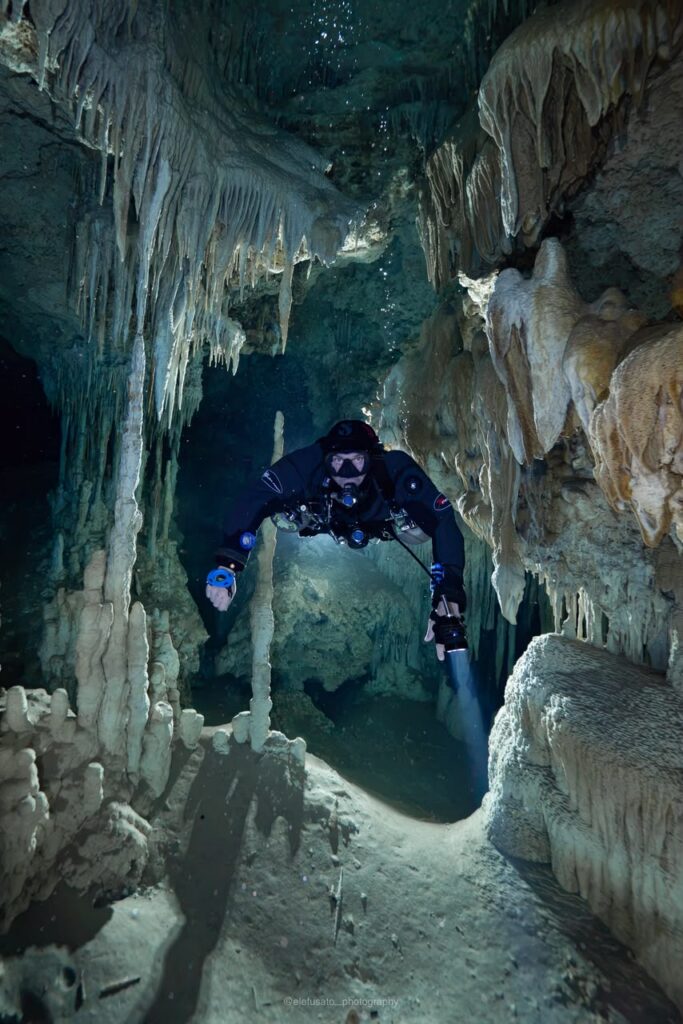
Divers frequently use the term Full Cave Diver when referring to a complete cave-diving certification.
Within the IANTD standards used for this program, the official certification name is IANTD Cave Diver.
For consistency with the certification actually issued, we primarily use the term Cave Diver. The term Full Cave is also used on this page because many divers search for this level using that commonly recognized terminology.
Regardless of the terminology, your actual diving limits are determined by:
- your training-agency standards;
- the equipment configuration in which you were trained;
- your other certifications;
- your actual experience;
- site conditions;
- the limits of the planned dive.
Recommended Progression Toward Cave Diver
For most divers, the most logical progression is:
- Cavern Diver;
- Introductory Cave Diver;
- Cave Diver.
This pathway allows you to progressively develop:
- buoyancy and propulsion techniques;
- guideline skills;
- zero-visibility exits;
- gas management;
- gas-sharing procedures;
- lost-line procedures;
- lost-diver procedures;
- cave navigation.
IANTD standards nevertheless provide two pathways toward Cave Diver certification.
Modular Pathway After Introductory Cave Diver
This pathway is designed for divers who already hold an IANTD Introductory Cave Diver certification or equivalent.
The minimum requirements are:
- Introductory Cave Diver certification or equivalent;
- minimum 50 logged dives;
- minimum age of 18;
- eight cave-training dives;
- minimum 400 minutes of cave bottom time.
This pathway allows you to develop the skills acquired during Introductory Cave training before progressively introducing more advanced navigation.
It is the progression we recommend for the majority of divers.
Pathway Without Introductory Cave Diver Certification
IANTD standards also provide a pathway for completing the Cave Diver program without previously holding an Introductory Cave Diver certification.
In this case, the candidate must:
- hold at least an IANTD Open Water Diver certification or equivalent;
- have at least 100 logged dives;
- be at least 18 years old;
- complete at least 12 cave-training dives;
- complete at least 500 minutes of cave bottom time.
Meeting these administrative requirements does not automatically mean that a diver is technically prepared for a direct Cave Diver program.
Excellent buoyancy, stable trim, appropriate stress management and relevant experience remain essential.
After the initial assessment, additional preparation or a modular progression may be recommended.
Why Take a Cave Diver Course in Mexico?
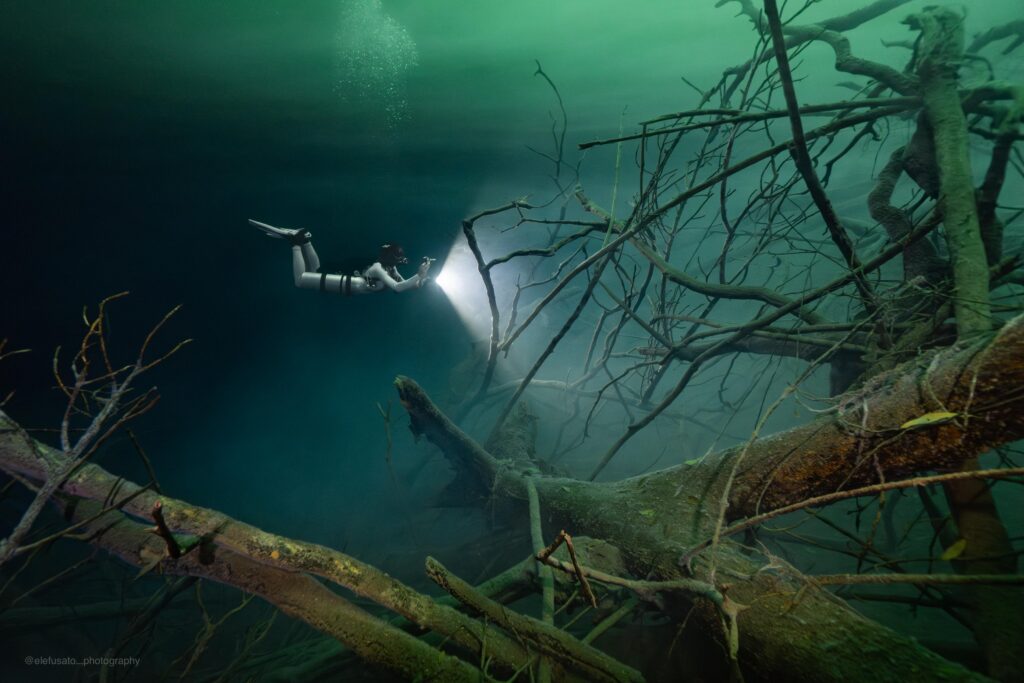
The Riviera Maya is home to an extraordinary network of flooded cave systems and is internationally recognized as one of the world’s major destinations for cave diving in Mexico.
The diversity of the cenotes allows you to experience different environments and characteristics, including:
- highly decorated passages;
- darker sections;
- haloclines;
- areas with fine sediment;
- depth changes;
- main lines and intersections;
- passages suitable for circuit training;
- sites suitable for traverses;
- environments where different emergency scenarios can be practised.
When conditions permit, IANTD standards require the program to use at least three different caves or mines.
Training in different environments helps prevent students from simply memorizing one site and requires them to apply their procedures in a variety of real cave-diving situations.
Why Choose the IANTD Cave Diver Certification?
IANTD — the International Association of Nitrox and Technical Divers — provides a complete cave-diving training pathway, from Cavern Diver to advanced technical overhead-environment programs.
The IANTD Cave Diver program places particular emphasis on:
- gas management;
- equipment redundancy;
- buoyancy control;
- propulsion techniques;
- guideline skills;
- zero-visibility procedures;
- regulator failures;
- communication;
- teamwork;
- cave navigation;
- decision-making.
Certification is based on demonstrated skill mastery.
The minimum number of dives and required bottom time are mandatory requirements, but completing them does not automatically guarantee certification.
Cave Diver Training in English in Mexico
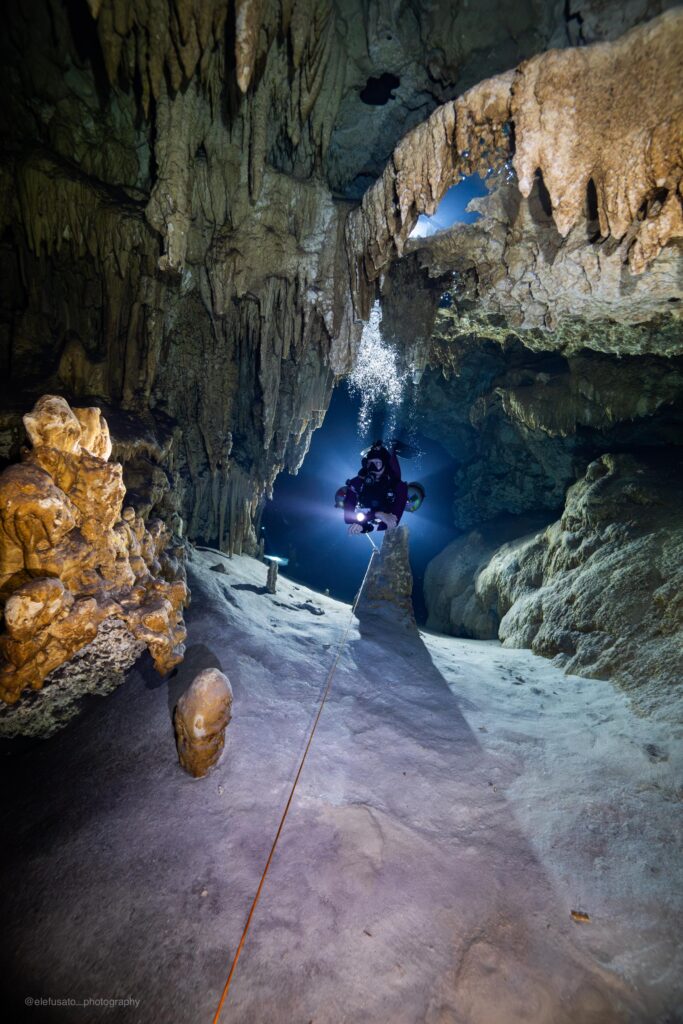
Cave diving involves complex procedures that must be fully understood.
At Halocline Explorers, your Cave Diver course in Playa del Carmen can be taught entirely in English.
Theory, gas calculations, exercises, briefings and debriefings can all be conducted in English.
Training is also available in French and Spanish.
The objective is for you to be able to:
- understand each procedure;
- explain why it is used;
- apply it in different situations;
- recognize your limits;
- make appropriate decisions without constantly depending on your instructor.
IANTD Cave Diver Course Program
The training program is adapted to your previous experience, equipment configuration and individual progression.
Theory and Dive Planning
Theory sessions include:
- the cave environment;
- physical and psychological factors;
- risk analysis;
- dive planning;
- the rule of thirds;
- gas balancing between team members;
- team procedures;
- communication;
- lines and navigation markers;
- lost-line procedures;
- lost-diver procedures;
- regulator failures;
- light failures;
- cave navigation;
- decompression;
- cave conservation.
Land Drills
Land drills allow you to practise:
- reel use;
- guideline installation;
- directional arrows;
- non-directional markers;
- gaps;
- interrupted lines;
- zero-visibility procedures;
- lost-line procedures;
- lost-diver procedures;
- touch communication;
- circuit and traverse planning.
Confined-Water Training
Confined-water sessions allow us to assess and develop:
- equipment configuration;
- buoyancy;
- horizontal trim;
- propulsion techniques;
- valve access;
- regulator switching;
- gas sharing;
- long-hose procedures;
- communication;
- zero-visibility exits;
- management of several tasks simultaneously.
Cave-Training Dives
The cave dives progressively integrate:
- dive planning and gas balancing;
- guideline installation;
- marker management;
- zero-visibility exits;
- gas-sharing exits;
- regulator-failure procedures;
- valve shutdowns;
- lost-line procedures;
- lost-diver searches;
- gaps;
- circuits;
- traverses;
- ascent and stop control.
Gas Management: The Rule of Thirds
IANTD Cave Diver standards require the rule of thirds.
The available gas is divided into three parts:
- one third for penetration;
- one third for the exit;
- one third retained as reserve.
This represents a maximum penetration limit. It is not an obligation to consume the entire first third.
Gas planning must also take into account:
- cylinder volume;
- cylinder pressure;
- actual available gas;
- each diver’s consumption;
- depth;
- cave profile;
- potential restrictions;
- current;
- estimated exit time;
- a potential gas-sharing emergency.
The dive is turned when the first limit within the team is reached.
Required Configuration: Doubles or Sidemount
A single-cylinder configuration is not permitted for the IANTD Cave Diver program.
The accepted configurations are:
- double cylinders with a dual-outlet manifold;
- sidemount configuration.
These configurations provide two accessible gas sources and allow the diver to manage regulator or valve failures.
Your equipment must be:
- appropriate for your body size;
- correctly configured;
- accessible;
- streamlined;
- familiar and fully mastered before complex cave dives.
Additional training may be recommended if you are not yet proficient with the configuration you intend to use.
Required Equipment for the Course
IANTD standards require equipment including:
- double cylinders or a sidemount configuration;
- a primary reel;
- a safety reel;
- at least one gap reel or spool;
- one primary light;
- two backup lights;
- three directional arrows;
- three non-directional markers;
- a slate or wetnotes;
- one primary cutting device;
- one backup cutting device;
- a regulator configuration suitable for gas sharing;
- instruments for monitoring time, depth and gas.
Every piece of equipment must be positioned logically and remain accessible during both normal diving and emergency procedures.
Gas-Sharing Exits
The training develops your ability to exit a cave when a teammate no longer has breathable gas available.
You will practise:
- identifying the problem;
- establishing contact with the donor;
- gas sharing using a long hose;
- stabilizing the team;
- communication;
- maintaining contact with the guideline;
- exiting with visibility;
- exiting without visibility;
- both donor and receiver roles.
Exercises are repeated until each student has performed both roles.
A gas-sharing scenario may also be initiated after the team has already begun the exit to simulate a more realistic emergency.
Zero-Visibility Procedures
Loss of visibility may result from:
- disturbed sediment;
- a lighting problem;
- a narrow passage;
- another diver’s movement;
- local deterioration of conditions.
The diver must remain capable of maintaining:
- contact with the guideline;
- contact with the team;
- stable buoyancy;
- controlled swimming speed;
- effective communication;
- appropriate gas management.
Training includes exits with closed eyes or lights switched off using:
- touch communication;
- Touch Contact;
- Bump and Go;
- gas sharing in zero visibility.
Managing a Regulator Failure
A regulator failure must be identified and isolated without losing control of the dive.
During at least three dives, the student must simulate a regulator failure.
You will learn to:
- identify or receive notification of the failure;
- switch to the functioning regulator;
- close the affected valve;
- verify your configuration;
- continue swimming without losing control;
- communicate with the team;
- confirm that all valves are correctly positioned afterward.
These procedures are performed while moving to develop a response that can actually be used during a cave dive.
Lost-Line Procedures
Losing the main guideline is a major emergency in a cave environment.
Training teaches you to:
- control your position;
- avoid uncontrolled movement;
- communicate with the team;
- use a safety reel;
- conduct a structured search;
- consider the geometry of the passage;
- manage time and gas;
- locate and secure the guideline;
- resume the exit.
The exercise develops method, discipline and the ability to remain controlled under pressure.
Lost-Diver Procedures
Separation from a member of the team requires a rapid but controlled response.
You will learn how to:
- recognize that a teammate is missing;
- maintain your reference toward the exit;
- communicate with the remaining team;
- organize a structured search;
- use available references and markers;
- monitor gas reserves;
- respect a defined search limit;
- begin the exit before compromising the safety of the remaining team.
A lost-diver procedure must never turn one missing diver into several divers in difficulty.
Cave Navigation
The Cave Diver program introduces several forms of underwater cave navigation.
Gap
A gap involves temporarily connecting two separated sections of guideline using a reel or spool.
Traverse
A traverse begins at one entrance and ends at another exit.
It requires precise planning of gas, references and potential return options.
Circuit
A circuit follows a loop that eventually returns toward the starting point or reconnects with a known section of the cave system.
The standards require completion of:
- one traverse;
- one gap;
- one circuit.
If site conditions do not permit a real circuit, the circuit may be simulated.
Depth and Decompression
The usual maximum depth for the IANTD Cave Diver program is 45 metres / 150 feet.
This depth is a limit, not a mandatory training objective.
IANTD standards permit decompression only using the gas carried in the diver’s primary configuration, or back gas.
Every dive must remain compatible with:
- the diver’s certifications;
- the breathing gases used;
- equipment configuration;
- experience;
- site conditions;
- the dive plan approved by the instructor.
IANTD standards include specific depth exceptions for certain Normoxic Trimix or Trimix divers when no shallower training site is available.
These exceptions are not part of the standard Cave Diver program normally conducted in the cenotes of the Riviera Maya.
Essential Course Information
Course: IANTD Cave Diver
Location: caves and cenotes of the Riviera Maya, Mexico
Minimum age: 18
Configuration: doubles or sidemount
Usual maximum depth: 45 metres / 150 feet
Gas management: rule of thirds
Decompression: back gas only
Different caves: minimum 3 when conditions permit
Maximum ratio: 3 students per instructor
Price: from MXN 5,000 per day
Languages: English, French or Spanish
Modular Pathway
Prerequisite: Introductory Cave Diver or equivalent
Minimum experience: 50 logged dives
Training dives: minimum 8
Cave bottom time: minimum 400 minutes
Pathway Without Introductory Cave Diver
Prerequisite: Open Water Diver or equivalent
Minimum experience: 100 logged dives
Training dives: minimum 12
Cave bottom time: minimum 500 minutes
Course Requirements
Candidates must be at least 18 years old.
For the modular pathway, you must:
- hold an IANTD Introductory Cave Diver certification or equivalent;
- have at least 50 logged dives;
- demonstrate mastery of Introductory Cave-level skills;
- use an appropriate doubles or sidemount configuration.
For the pathway without Introductory Cave, you must:
- hold an IANTD Open Water Diver certification or equivalent;
- have at least 100 logged dives;
- demonstrate excellent mastery of fundamental diving skills;
- use an appropriate doubles or sidemount configuration.
In both cases, you must also:
- be medically fit to dive;
- complete the medical questionnaire;
- provide your certifications;
- provide your dive log;
- have appropriate recent diving experience;
- demonstrate appropriate buoyancy, trim and propulsion;
- be capable of managing several tasks simultaneously;
- accept an honest initial assessment of your current ability.
Meeting the administrative minimums does not guarantee final admission to the program or certification.
What Can You Do After Your Cave Diver Certification?
After successfully meeting the program requirements, you can plan and conduct cave dives with appropriately qualified dive partners within the limits of your training and experience.
Depending on the planned dive, you may use:
- a continuous main guideline;
- gaps;
- traverses;
- circuits;
- the navigation procedures covered during training;
- the equipment configuration in which you are qualified.
You must always respect:
- the rule of thirds;
- applicable depth limits;
- breathing-gas limitations;
- your mastered equipment configuration;
- any other required certifications;
- site conditions;
- the actual capabilities of the team.
Cave Diver certification does not automatically qualify you for solo cave diving, DPV cave diving, multistage diving, advanced restrictions, cave sidemount without appropriate training, rebreather cave diving or extended decompression.
These activities require additional experience and specific training.
Why Train with Halocline Explorers?
A Cave Diver certification should prepare you to make responsible decisions, not simply teach you how to pass a series of drills.
At Halocline Explorers, we emphasize:
- honest assessment of your initial skill level;
- small groups;
- personalized progression;
- clean and well-mastered equipment configuration;
- precise buoyancy control;
- appropriate propulsion techniques;
- conservative gas management;
- high-quality guideline work;
- mastery of emergency exits;
- communication and team cohesion;
- cave conservation;
- the ability to call a dive whenever necessary.
Julien Garnier is an IANTD Instructor Trainer specializing in technical diving, sidemount, rebreather and cave diving.
His field experience allows training scenarios, sites and progression to be adapted to each candidate’s actual abilities.
Cave Diver Course Duration and Price
IANTD establishes minimum numbers of dives and minimum cave bottom times, but total course duration depends on the selected pathway and individual progression.
Price: from MXN 5,000 per day.
The total cost depends on:
- modular or direct pathway;
- number of training days required;
- number of dives;
- equipment configuration;
- equipment requirements;
- cylinders and gases;
- cenote entrance fees;
- training materials;
- applicable certification fees.
All inclusions, exclusions, sites and fees are confirmed before booking.
Frequently Asked Questions About the Cave Diver Course
Are Cave Diver and Full Cave Diver the Same Thing?
Full Cave Diver is a term commonly used by cave divers. In the IANTD standards used for this program, the official certification name is Cave Diver.
Your actual diving limits remain defined by the standards, your equipment configuration, other certifications and experience.
Do I Need to Be an Introductory Cave Diver?
The modular pathway requires an Introductory Cave Diver certification or equivalent.
IANTD also provides a pathway without Introductory Cave for Open Water Divers or equivalent with at least 100 logged dives. This pathway requires additional dives and cave bottom time.
How Many Logged Dives Do I Need?
The modular pathway requires at least 50 logged dives.
The pathway without Introductory Cave requires at least 100 logged dives.
How Many Training Dives Are Required?
The modular pathway requires at least eight cave dives.
The pathway without Introductory Cave requires at least twelve cave dives.
What Is the Minimum Cave Bottom Time?
The modular pathway requires at least 400 minutes of cave bottom time.
The pathway without Introductory Cave requires at least 500 minutes.
How Long Does the Cave Diver Course Take?
IANTD standards specify minimum numbers of dives and bottom time rather than an identical course duration for every student.
Duration depends on your training pathway, equipment configuration, experience and progression.
What Is the Minimum Age?
Candidates must be at least 18 years old.
Can I Complete the Course with a Single Cylinder?
No.
The Cave Diver program requires double cylinders with an appropriate manifold or a sidemount configuration.
What Gas-Management Rule Is Used?
IANTD Cave Diver standards require the rule of thirds.
What Is the Maximum Depth?
The usual maximum depth is 45 metres / 150 feet.
This is a limit rather than a mandatory objective and remains subject to qualifications, gases, site conditions and dive planning.
Is Decompression Allowed?
IANTD standards permit decompression using only the gas contained in the primary configuration.
Any decompression dive must also remain within the diver’s other applicable qualifications and limits.
How Many Lights Are Required?
One primary light and two backup lights are required, for a total of three lights.
Which Reels Are Required?
You need a primary reel, a safety reel and at least one gap reel or spool.
Which Line Markers Are Required?
The standards require three directional arrows and three non-directional markers.
Will I Learn Complex Cave Navigation?
The training includes a gap, traverse and circuit.
The circuit may be simulated when site conditions do not allow it to be completed as an actual circuit.
Can I Dive Sidemount After Completing the Course in Doubles?
You must use an equipment configuration for which you are appropriately trained and competent.
Sidemount in an overhead environment involves specific considerations, so additional training or evaluation may be required before changing configuration.
Can I Dive Solo After Certification?
No.
The Cave Diver program is not a solo-diving certification.
Does Cave Diver Certification Allow Me to Use a DPV or Rebreather in a Cave?
No.
DPV and rebreather use in a cave environment require specific qualifications.
Can I Take the Course in English?
Yes.
The entire Cave Diver course can be taught in English, as well as French or Spanish.
How Much Does the Cave Diver Course Cost?
Training starts from MXN 5,000 per day.
The total cost depends on your pathway, number of training days, equipment configuration, gases, entrance fees and logistical requirements.
How Do I Book the Cave Diver Course?
Send us your preferred dates, current certifications, number of logged dives, previous cave-diving experience, equipment configuration and training objectives.
We will review your experience and prerequisites before confirming the training program.
Become a Cave Diver in the Cenotes of Mexico
Would you like to develop genuine autonomy in cave diving and learn how to manage navigation, loss of visibility and emergency situations in the flooded cave systems of the Riviera Maya?
The IANTD Cave Diver course in Playa del Carmen offers demanding, structured and personalized training in one of the world’s most renowned cave-diving destinations.
You will benefit from small groups, personalized progression and the experience of an IANTD Instructor Trainer specializing in cave diving.
Join Halocline Explorers
Ready to explore some of the most spectacular diving environments in the Riviera Maya?
Our team will help you enjoy a safe, personalized and unforgettable diving experience.
Cenotes • Cozumel • Playa del Carmen • Technical Diving • IANTD Training
Small groups. High safety standards. Professional instruction.




