
Sidemount Diver Course in Playa del Carmen
Learn to dive with cylinders positioned along your sides with the IANTD Sidemount Diver course in Playa del Carmen.
This course teaches you to configure your equipment correctly, control your buoyancy, manage independent gas sources and perform the safety procedures required for sidemount diving.
Organized over two to three days, the course includes academic training, a confined-water session and at least three sidemount dives in the Riviera Maya.
Duration: 2 to 3 days
Program: Theory, confined water and at least 3 dives
Minimum bottom time: 120 minutes
Maximum depth: Limited by your current certification
Price: From 5,000 MXN per day
Certification: IANTD Sidemount Diver
Languages: English, French or Spanish
Discover Sidemount Diving in Mexico
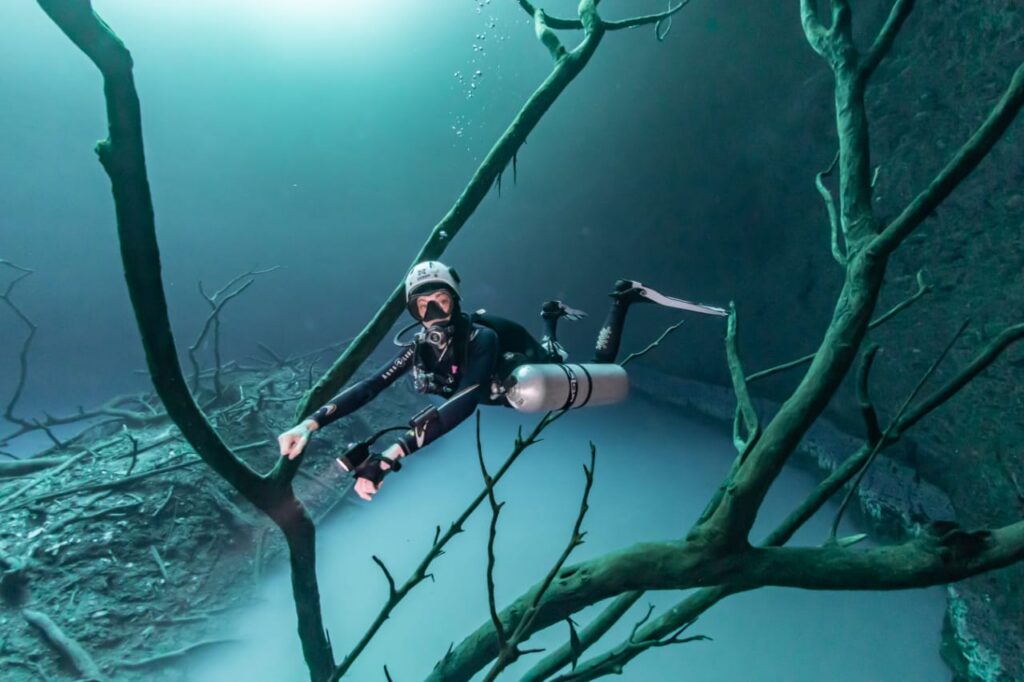
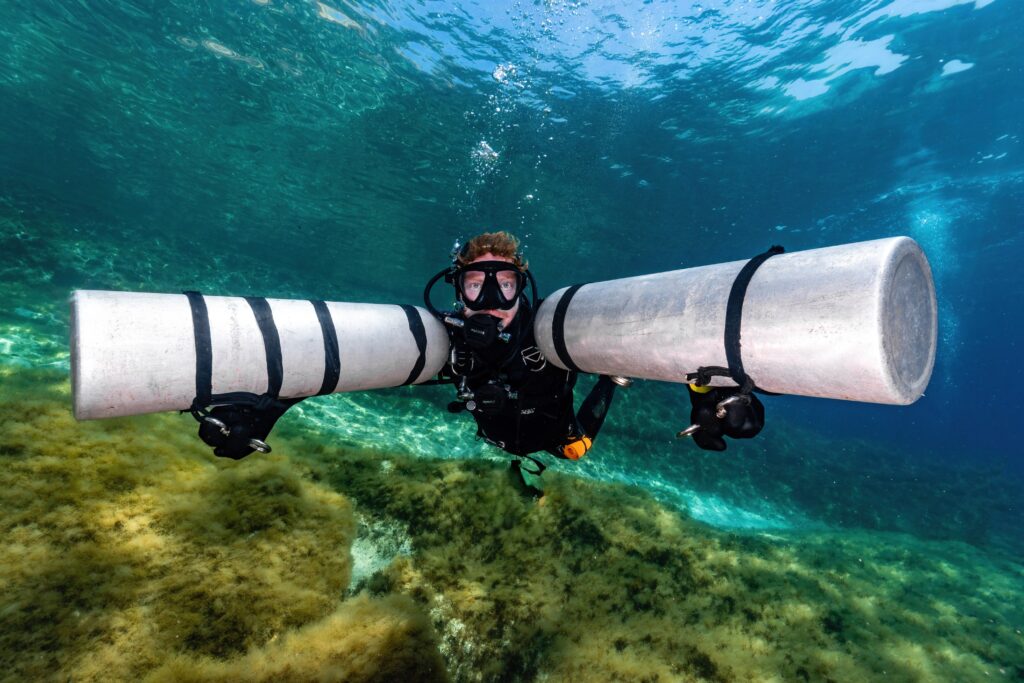
In a sidemount configuration, the cylinders are positioned along the sides of the diver’s body instead of being mounted on the back.
This configuration provides direct access to each cylinder and valve while distributing the equipment differently around the diver’s body. The cylinders can also be attached or removed in the water when conditions allow.
However, sidemount diving requires precise equipment configuration. Cylinder position, harness adjustment, regulator routing and gas management must all be adapted to the individual diver.
Proper training is therefore essential to experience the real benefits of sidemount diving without developing inefficient or unsafe habits.
Why Complete a Sidemount Diver Course?
Sidemount is not simply about moving cylinders from your back to your sides. It changes the way you prepare your equipment, manage your gas and respond to problems.
A sidemount course allows you to:
- access your cylinder valves directly;
- manage independent gas sources;
- improve your underwater body position;
- develop a better understanding of your equipment;
- adapt the configuration to your body;
- facilitate selected water entries and exits;
- control cylinder balance throughout the dive;
- improve hydrodynamics when the system is correctly configured;
- prepare for future technical or cave sidemount training.
The real advantages of sidemount become apparent only when the equipment is properly configured and the required procedures are mastered.
Why Learn Sidemount in Playa del Carmen?
The Riviera Maya is one of the world’s most recognized destinations for sidemount diving.
The development of cave diving in Mexico’s cenotes has contributed significantly to the evolution of modern sidemount configurations. The region is now home to a large community of divers using sidemount for recreational, technical and cave diving.
Dive sites around Playa del Carmen provide suitable environments for progressively developing:
- equipment configuration;
- buoyancy control;
- trim;
- regulator switching;
- cylinder handling;
- gas-sharing procedures;
- surface marker buoy deployment;
- controlled ascents.
The Sidemount Diver course remains an open-water training program. It does not qualify you to enter a cave, cavern or other overhead environment without the appropriate training and certification.
Why Choose the IANTD Sidemount Diver Certification?
IANTD, the International Association of Nitrox and Technical Divers, offers sidemount courses for different levels of recreational, technical and cave diving.
The IANTD Sidemount Diver course is designed to familiarize you with the equipment, techniques and mindset required to use a sidemount configuration correctly.
The course teaches you to:
- assemble your equipment;
- adjust the harness and buoyancy system;
- prepare the regulators;
- position the cylinders;
- manage multiple gas sources;
- operate the cylinder valves;
- perform the required safety procedures;
- dive with a clean and balanced configuration.
The certification is internationally recognized and can provide the first step toward more advanced sidemount training.
Sidemount Training in English in Mexico
Correctly adjusting a sidemount configuration requires precise explanations and repeated corrections.
At Halocline Explorers, your Sidemount Diver course in Playa del Carmen can be taught entirely in English.
Every part of your equipment is examined so that you understand its position, purpose and effect on your body position underwater.
The course is not about blindly copying a configuration. You will learn to understand your equipment so that you can later perform your own checks and adjustments.
Training is also available in French and Spanish.
Sidemount Diver Course Program
The course is generally organized over two to three days. Its precise duration depends on your experience, buoyancy control and progression.
Certification is performance-based. An additional day may be required if the course objectives have not yet been achieved.
Day 1 – Theory, Equipment Configuration and Confined Water
The first day is dedicated to understanding and adjusting the sidemount system.
You will learn to:
- identify the different components of the system;
- adjust the harness to your body;
- position the buoyancy system;
- prepare the regulators and pressure gauges;
- organize hose routing;
- configure the cylinders;
- adjust the attachment points;
- verify access to the cylinder valves;
- balance the position of the cylinders;
- complete the required pre-dive checks.
A confined-water session then allows you to test the configuration and make the first adjustments.
Day 2 – Buoyancy, Trim and Procedures
The initial dives focus on:
- weighting;
- buoyancy control;
- horizontal trim;
- propulsion techniques;
- regulator switching;
- alternating gas management;
- valve checks;
- valve shutdowns;
- bolt-snap handling;
- cylinder position during the dive.
Adjustments are made between dives to progressively improve your comfort, balance and stability.
Day 3 – Proficiency and Diving Scenarios
When three days are required, the final day is used to consolidate your skills and apply them during more complete scenarios.
You will work on:
- simulated regulator failures;
- valve shutdowns;
- stationary gas sharing;
- gas sharing while swimming;
- gas-sharing ascents;
- handling a detached cylinder;
- deploying a surface marker buoy;
- performing a controlled ascent;
- maintaining a stable safety stop.
Sidemount Equipment Configuration
A sidemount configuration must be adapted to the diver’s body, the cylinders being used and the type of diving planned.
The equipment generally includes:
- a sidemount harness;
- a suitable wing or buoyancy system;
- one or two side-mounted cylinders;
- an independent regulator for each cylinder;
- a pressure gauge for each gas source;
- bolt snaps and attachment points;
- a dive computer;
- a cutting device;
- a surface marker buoy and spool.
Each gas source must be monitored independently.
The course teaches you to understand and adjust the complete system rather than depend on a fixed configuration.
What You Will Learn During the Course
The IANTD Sidemount Diver course includes:
- assembling and adjusting the sidemount system;
- cylinder preparation;
- regulator and hose routing;
- alternating gas management;
- bubble checks;
- valve checks;
- regulator switching;
- valve shutdowns;
- buoyancy control;
- maintaining proper trim;
- different propulsion techniques;
- water entries and exits with cylinders;
- attaching cylinders in the water;
- detaching and repositioning a cylinder;
- gas-sharing procedures;
- gas-sharing ascents;
- surface marker buoy deployment;
- controlled ascents and safety stops.
Essential Information
Course: IANTD Sidemount Diver
Location: Playa del Carmen, Riviera Maya, Mexico
Duration: 2 to 3 days
Sidemount dives: Minimum of 3
Minimum bottom time: 120 minutes
Confined-water training: Mandatory
Maximum depth: Limited by your current certification
Mandatory decompression: Not permitted at recreational level
Overhead environment: Not included
Price: From 5,000 MXN per day
Languages: English, French or Spanish
Course Requirements
To participate in the IANTD Sidemount Diver course, you must hold an Open Water Diver certification or equivalent.
The Open Water Diver and Sidemount Diver courses may also be combined, provided that all standards and requirements for both programs are completed.
You must also:
- be medically fit to scuba dive;
- complete the required medical questionnaire;
- have appropriate recent diving experience;
- master the fundamental Open Water skills;
- be reasonably comfortable with your buoyancy;
- present your current certification.
The minimum age for the full certification is 15 with parental or legal-guardian authorization, or 18 without authorization.
A Junior Sidemount Diver certification may be available for participants between 12 and 14 years old with parental authorization.
How Deep Can You Dive in Sidemount?
The Sidemount Diver course does not increase your maximum certification depth.
Your maximum depth remains determined by your current certification:
- Open Water Diver: maximum 18 metres/60 feet;
- Advanced Open Water Diver: maximum 30 metres/100 feet;
- Deep Diver: maximum 40 metres/130 feet.
Dives completed during the course cannot exceed the depth permitted by your previous certification.
Dives requiring mandatory decompression stops are not permitted during the recreational Sidemount Diver course.
Recreational, Technical or Cave Sidemount?
Recreational, Technical or Cave Sidemount?
These courses have different objectives and requirements.
Recreational Sidemount Diver
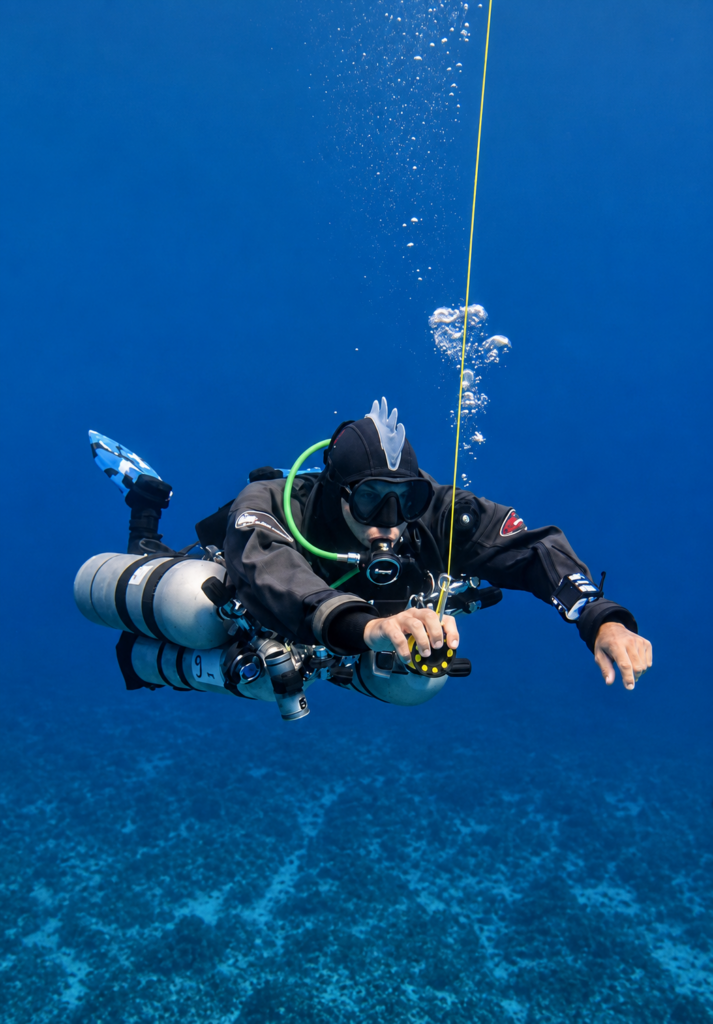
The course presented on this page teaches you to use sidemount in open water, within the limits of your recreational diving certification.
Technical Sidemount Diver
Technical Sidemount training adds the configuration, procedures and skills required for technical diving and the management of additional equipment.
It has its own specific prerequisites and certification standards.
Cave Sidemount Diver
Using sidemount inside a cave requires both an appropriate cave-diving certification and sidemount training adapted to overhead environments.
The Sidemount Diver certification alone never qualifies you to enter a cave or pass through a restriction.
Why Train With Halocline Explorers?
Sidemount diving is particularly sensitive to small configuration details. Incorrect attachment points or cylinder positioning can affect buoyancy, trim and access to the valves.
At Halocline Explorers, we focus on:
- a configuration adapted to your body;
- understanding every equipment component;
- progressive adjustment of the system;
- a clean and balanced underwater position;
- precise management of both cylinders;
- direct access to the valves;
- mastery of safety procedures;
- the ability to make your own adjustments.
Halocline Explorers’ experience in technical sidemount and cave diving allows us to teach a functional and adaptable configuration while respecting the limits of a recreational course.
What Can You Do After Certification?
After earning your IANTD Sidemount Diver certification, you will be qualified to use a sidemount configuration during open-water dives within your current depth and decompression limits.
You can then:
- gain additional sidemount experience;
- continue improving your configuration;
- complete recreational ocean dives;
- progress toward Technical Sidemount;
- complete Cavern or Cave training if you meet the prerequisites;
- use sidemount during compatible training programs;
- continue developing your buoyancy and propulsion techniques.
The certification provides a foundation. Regular practice remains essential for maintaining and improving the skills developed during the course.
Learn Sidemount in the Heart of the Riviera Maya
Playa del Carmen and the cenotes of the Riviera Maya hold an important place in the history and evolution of modern sidemount diving.
Completing your course in Mexico allows you to discover this configuration in an environment particularly well suited to buoyancy, trim and cylinder-management training.
Halocline Explorers provides progressive and personalized sidemount training entirely in English.
Duration: 2 to 3 days
Dives: Minimum of 3
Minimum bottom time: 120 minutes
Price: From 5,000 MXN per day
Frequently Asked Questions About the Sidemount Diver Course
What Is Sidemount Diving?
Sidemount is an equipment configuration in which the cylinders are positioned along the diver’s sides instead of being mounted on the back.
What Certification Do I Need?
You must hold an Open Water Diver certification or equivalent. Your experience and buoyancy control will be assessed before the course.
How Long Does the Sidemount Course Take?
The course is generally organized over two to three days. Its duration depends on your experience and progression.
How Many Dives Are Required?
IANTD standards require a minimum of three sidemount dives and 120 minutes of open-water bottom time.
How Much Does the Sidemount Course Cost?
The price starts from 5,000 MXN per day. The total cost depends on the duration of the program and equipment requirements.
Is Sidemount Equipment Included?
Equipment requirements must be confirmed before the course. If you already own a sidemount system, its compatibility and configuration will be checked before training begins.
Can I Learn With a Single Cylinder?
IANTD standards permit different configurations that meet the minimum gas-volume and safety requirements. The configuration selected will depend on your objectives and the equipment used.
Does the Course Allow Me to Dive Deeper?
No. Your maximum depth remains determined by your current certification.
Can I Cave Dive After This Course?
No. The Sidemount Diver certification is not a cave-diving qualification. Specific Cavern or Cave training is mandatory before entering an overhead environment.
Can the Course Be Conducted in Cenotes?
The course may use open-water areas suitable for sidemount training. It does not include cave penetration or passages requiring an advanced sidemount or cave-diving certification.
Can I Take the Course in English?
Yes. The course can be taught entirely in English in Playa del Carmen. It is also available in French and Spanish.
Do I Need a Nitrox Certification?
Nitrox certification is not mandatory for the recreational Sidemount Diver course. Additional requirements may apply depending on the volume of gas used or for more advanced training programs.
Which Course Should I Take Next?
Depending on your objectives and experience, you may progress toward Technical Sidemount, Advanced Nitrox, Cavern Diver or Cave Diver training.
How Can I Book My Sidemount Course?
Send us your preferred dates, current certification, number of logged dives, previous sidemount experience and information about any equipment you own. We will recommend the appropriate duration and configuration.